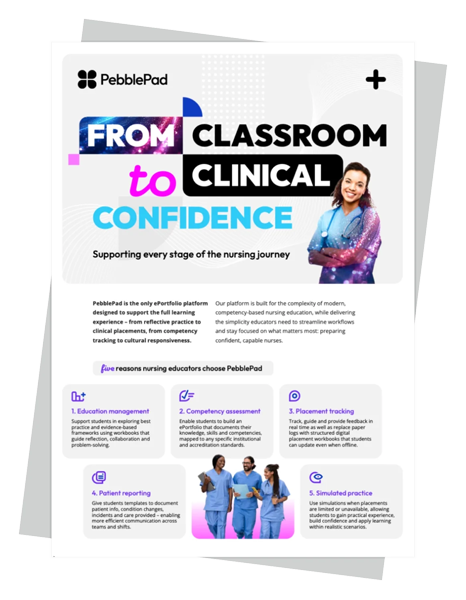
PebblePad integrates ePortfolios, digital workbooks and assessment tools into a single digital platform to support every aspect of nursing education – from reflective practice and clinical placements to helping students grow in confidence, cultural understanding, career readiness and a commitment to lifelong learning.
Built for the realities of modern, competency-based nursing programmes, PebblePad helps educators simplify complex processes and focus on what really counts: preparing nurses who are capable, confident and ready for clinical practice.
Trusted by hundreds of institutions worldwide including:
“PebblePad and its reporting captures all our data—it’s a huge component that helps us meet students where they need us.”
Disjointed systems and paper-based portfolios can make it difficult to deliver a coherent and well-structured nursing curriculum.
PebblePad brings everything together – reducing administrative burden, improving visibility and enhancing outcomes. Here’s how we support nursing education in three key phases:
1.Structured Learning, Streamlined Delivery
Supporting standards-aligned teaching from day one.
PebblePad strengthens classroom learning by integrating assessment, reflection and feedback into a single platform – making it easier to deliver structured, competency-based education.
Unified learning environment
Consolidate ePortfolios, templates and assessment tools – eliminating the need to juggle multiple systems and tools.
Scaffolded reflection
Use guided workbooks to foster reflective thinking, collaboration and clinical reasoning – rooted in evidence-informed practice.
Ditch paper portfolios in favour of a centralised system that enables ongoing assessment and timely feedback.
Secure digital storage
Ensure student work is protected and recoverable – giving educators and learners true peace of mind.
“The immediacy that PebblePad offers has transformed the flow of the learning experience.”
University of South Australia
Meeting standards with confidence
PebblePad’s flexible templates and assessment tools align with national and institutional frameworks making it easier to evidence competency, support accreditation and report on outcomes at scale.
2.Clinical Learning, Real-Time Support
Helping students thrive in placements and simulated environments.
PebblePad equips nursing students with the tools they need to navigate clinical placements and simulation-based learning with confidence. Our platform ensures continuity of learning – even when offline – and strengthens communication through structured, professional documentation.
Placement support
Guide and assess students in real time, replacing paper logs with digital workbooks that can be updated offline.
Simulation templates
Enhance clinical readiness using scenario-based templates that mirror real-world contexts – invaluable when placement opportunities are limited.
Structured documentation
Capture patient care, incidents and condition changes using structured templates to enhance communication between teams.
Learning on the go
Students often find it challenging to document learning consistently while on placement – especially without internet access. The PebblePocket mobile app makes it simple, allowing learners to record experiences using photos, audio, video or notes offline, before syncing all new assets once back online.
“To be able to jump in, in real time, to see what is happening for students in practice and provide more timely support to them and their facilitating nurses has been a game changer.”
University of Tasmania
3.Meaningful Assessment, Lasting Impact
Championing professional standards, digital capability and lifelong learning.
PebblePad helps educators maintain high standards while reducing admin through digital-first workflows and multimodal evidence collection – supporting authentic learning and long-term professional development.
Digital fluency for healthcare
Develop digital literacy and reflective skills in environments that mirror today’s clinical settings.
Genuine, practice-based evidence
Encourage submissions that go beyond written work, using video, audio and imagery to build a credible, auditable record of learning.
Reduce admin with digital tools designed to streamline moderation and boost student engagement.
Continuity beyond graduation
Enable graduates to retain access to their portfolios – making CPD tracking and professional reflection seamless throughout their careers.
“Utilizing PebblePad … serves as a powerful tool to showcase tangible examples of learning and growth throughout the entire nursing student journey.”
Royal Melbourne Institute of Technology
Data you can trust
PebblePad is built on secure, cloud-based infrastructure with single sign-on (SSO) and role-based permissions – ensuring data remains protected, accessible and fully under your institution’s control.
Nursing Webinars
Explore our webinar series to hear from leading educators on building clinical confidence, bridging theory with practice and preparing nurses for today’s healthcare environments.
Nursing Videos
Watch nursing educators share how PebblePad has transformed their teaching, assessment and student support.
Discover the power of PebblePad – a platform designed to elevate educator impact and student success through ePortfolios, workbooks and authentic assessment.
The event agenda is correct at the time of publishing. As with all events, we may need to alter or modify aspects of the agenda.
While we take every precaution to ensure the safety and security of our events, Pebble Learning Ltd recommends you review insurance policies to ensure adequate coverage, especially in the realm of business travel.
We will be recording (audio/video) the presentations during the event. A conference photographer will also be capturing moments for our highlights reel. The video and photography will be used to share insights and market PebbleBash to the wider HE community. We do not give automatic refunds, please see the cancellation policy in the FAQs.
Curriculum Transformation at the University of Edinburgh: co-creation and the relationship between local innovation and institutional change
Talk description: I will use the themes of reflection and experiential learning, skills development and assessment (including programme level assessment and changes in assessment practice) to explore this process in more detail. This includes the link between disciplinary and institutional curriculum reform, learning from local innovations and changes, and using this to inform University level changes and support.
Bio:My current position is leading the University wide Curriculum Transformation Project. This is a major and long term initiative for the University considering all areas of the University’s undergraduate and taught postgraduate curriculum. Prior to this Jon set up and led the Institute for Academic Development (IAD) at the University of Edinburgh. The IAD provides University level support for teaching, learning and researcher development, including direct support for students and staff, and support for enhancement and innovation in curriculum development, the student and researcher experience. Jon has a PhD in petroleum geology.
Mission Possible: The DNA of a bespoke professional development program
Talk description: The diversity of students in higher education dictates that there cannot (and should not) be a single ‘silver bullet’ approach to address the complex challenge of career readiness learning. However, the reality of modern university structures is that delivering bespoke experiences for each student is a challenge in and of itself. And yet, all things are possible with creative use of PebblePad to streamline delivery (for the university) and make it highly personalised (for the student).
Bio: Gayle Brent is a Learning and Teaching Consultant (Employability) at Griffith University, Queensland, Australia. Gaye’s specialist area of interest is developing and implementing strategies to enhance staff and student understanding of employability in both curricular and extra-curricular contexts. She completed a Master of Education and Professional Studies Research to explore the potential barriers and challenges to embedding employability-based learning in higher education curriculum and is currently completing a Doctor of Philosophy exploring the impact of an extra-curricular employability program on the individual student experience.
Dr Melissa Highton. Assistant Principal, University of Edinburgh
Talk description: A journey through the stories told by wicca data. How a neglected research data set was used by students to overturn historic injustice and shed new light on the lives of women in Scotland.
Bio: Melissa has worked for many years in higher education at some of the UK’s finest and most ancient institutions. In each place she enjoys discovering the hidden histories and less heard voices which can be surfaced in new ways using the most up to date and open technologies. She is a champion of playful and curious approaches to engagement with audiences on campus and online, and is an invited speaker at events about dangerous women.
Education is an Experience That Should Be Designed
Talk description: We have any number of problems and opportunities as universities, and universities must adapt to help students from diverse backgrounds develop the knowledge and skills they need to thrive and make a positive impact in the world. Key to those adaptations is understanding that we provide students with an experience. We ought to design them with intention and purpose. This talk with take up this argument and ground it within a large educational transformation project at the University of Leeds.
Bio: Jeff Grabill is Deputy Vice Chancellor for Student Education at the University of Leeds. Prior to joining the University of Leeds, Grabill was at Michigan State University (MSU) in the United States for nearly 20 years. He served Michigan State University as the Associate Provost for Teaching, Learning, and Technology. In that role, he was responsible for facilitating innovation in learning and educator professional development via his role as Director of the Hub for Innovation in Learning and Technology. Grabill’s research focuses on how digital writing is associated with citizenship and learning. That work has been located in community contexts, in museums, and in classrooms at both the K-12 and university levels. Grabill is also a co-founder of Drawbridge, an educational technology company.