



Search
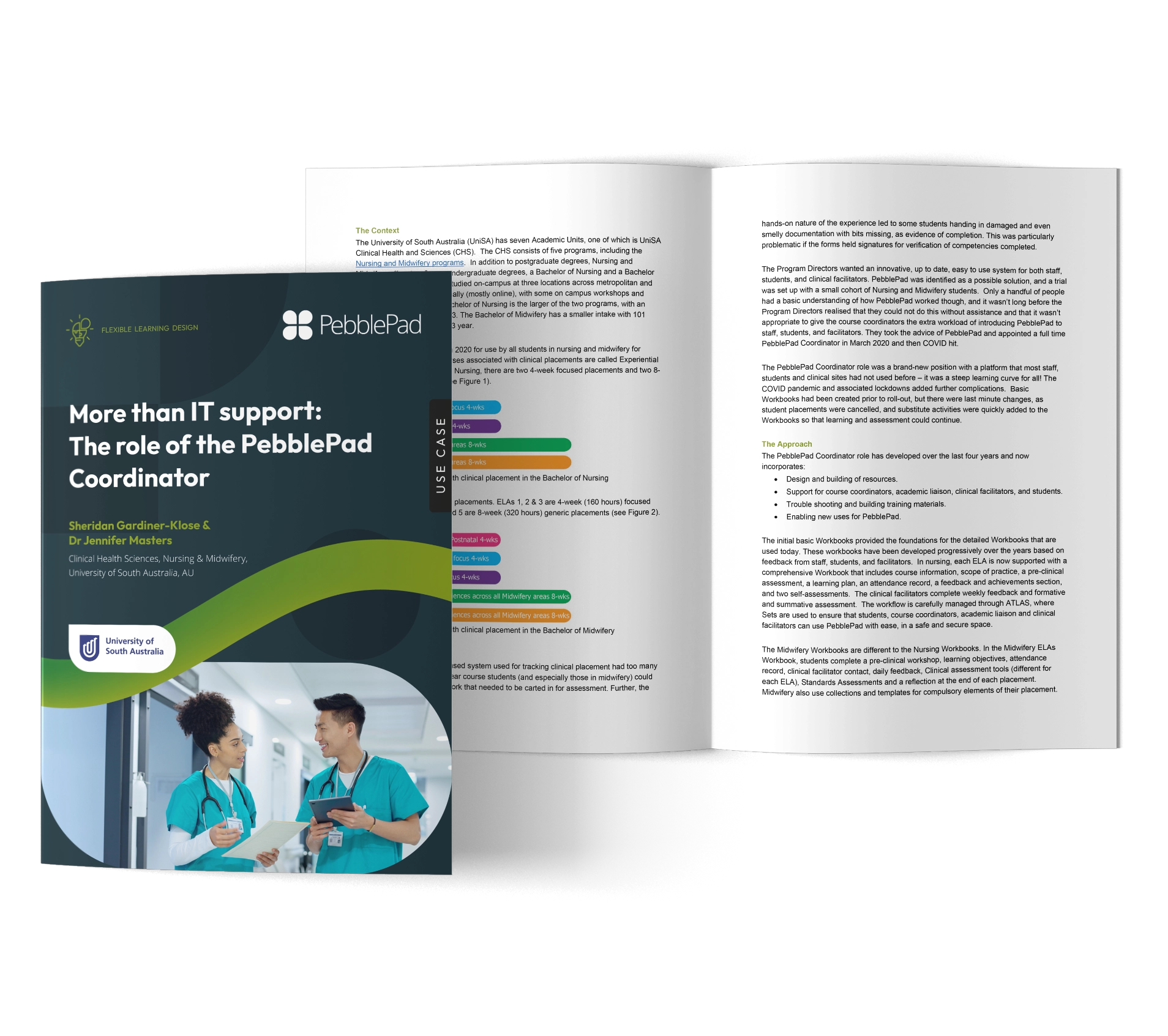
University of South Australia - PebblePad Use Case
University of south Australia

Revolutionising Clinical Placement Tracking

More-than-IT-Support,-University-of-South-Australia

Sheridan Gardiner-Klose & Dr Jennifer Masters

Explore how PebblePad played a transformative role in clinical placement tracking in the Nursing and Midwifery programmes at the University of South Australia.

In this use case featured at PebbleBash 2024, Course Development Coordinator Sheridan Gardiner-Klose and PebblePad’s Dr Jennifer Masters reveal how, over four years, the university’s PebblePad solution has been developed under the guidance of a dedicated inhouse PebblePad Coordinator to:

  • Create and constantly evolve workbooks and portfolio collections based on staff, student and facilitator feedback and the specific course requirements.
  • Provide an intuitive and secure system that replaces the vast volumes of paper volumes needed for assessment with electronically stored data sets.
  • Allow staff to access documentation, verify assets and capabilities, and provide feedback and summary updates effectively and quickly – even instantly.
  • Create a responsive design, enabling the university’s PebblePad implementation to evolve as contexts, content and players change over time.
  • Facilitate new and emerging use cases including implementing PebblePad to support students at placement sites where the internet connection isn’t ideal.

Ultimately, the use case reveals how PebblePad has evolved to become an essential component of clinical placement programmes – and, most importantly, ensure the days of misplaced or damaged workbooks are now consigned to the past.

To discover how to help your nursing and midwifery students evidence their learning through a secure system rather than on paper, download the exclusive use case now. 
share

Download Case Study

More Case Studies

Professional Identity & Capability

View all Case Studies

Trusted by hundreds of institutions worldwide including:

Curriculum Transformation at the University of Edinburgh: co-creation and the relationship between local innovation and institutional change

Talk description: I will use the themes of reflection and experiential learning, skills development and assessment (including programme level assessment and changes in assessment practice) to explore this process in more detail. This includes the link between disciplinary and institutional curriculum reform, learning from local innovations and changes, and using this to inform University level changes and support.

Bio: My current position is leading the University wide Curriculum Transformation Project. This is a major and long term initiative for the University considering all areas of the University’s undergraduate and taught postgraduate curriculum. Prior to this Jon set up and led the Institute for Academic Development (IAD) at the University of Edinburgh. The IAD provides University level support for teaching, learning and researcher development, including direct support for students and staff, and support for enhancement and innovation in curriculum development, the student and researcher experience. Jon has a PhD in petroleum geology.

Mission Possible: The DNA of a bespoke professional development program

Talk description: The diversity of students in higher education dictates that there cannot (and should not) be a single ‘silver bullet’ approach to address the complex challenge of career readiness learning. However, the reality of modern university structures is that delivering bespoke experiences for each student is a challenge in and of itself.  And yet, all things are possible with creative use of PebblePad to streamline delivery (for the university) and make it highly personalised (for the student). 

Bio: Gayle Brent is a Learning and Teaching Consultant (Employability) at Griffith University, Queensland, Australia. Gaye’s specialist area of interest is developing and implementing strategies to enhance staff and student understanding of employability in both curricular and extra-curricular contexts. She completed a Master of Education and Professional Studies Research to explore the potential barriers and challenges to embedding employability-based learning in higher education curriculum and is currently completing a Doctor of Philosophy exploring the impact of an extra-curricular employability program on the individual student experience.

Dr Melissa Highton. Assistant Principal, University of Edinburgh

Talk description: A journey through the stories told by wicca data. How a neglected research data set was used by students to overturn historic injustice and shed new light on the lives of women in Scotland.

Bio: Melissa has worked for many years in higher education at some of the UK’s finest and most ancient institutions. In each place she enjoys discovering the hidden histories and less heard voices which can be surfaced in new ways using the most up to date and open technologies. She is a champion of playful and curious approaches to engagement with audiences on campus and online, and is an invited speaker at events about dangerous women.

Education is an Experience That Should Be Designed

Talk description: We have any number of problems and opportunities as universities, and universities must adapt to help students from diverse backgrounds develop the knowledge and skills they need to thrive and make a positive impact in the world. Key to those adaptations is understanding that we provide students with an experience. We ought to design them with intention and purpose. This talk with take up this argument and ground it within a large educational transformation project at the University of Leeds.

Bio: Jeff Grabill is Deputy Vice Chancellor for Student Education at the University of Leeds. Prior to joining the University of Leeds, Grabill was at Michigan State University (MSU) in the United States for nearly 20 years. He served Michigan State University as the Associate Provost for Teaching, Learning, and Technology. In that role, he was responsible for facilitating innovation in learning and educator professional development via his role as Director of the Hub for Innovation in Learning and Technology. Grabill’s research focuses on how digital writing is associated with citizenship and learning. That work has been located in community contexts, in museums, and in classrooms at both the K-12 and university levels. Grabill is also a co-founder of Drawbridge, an educational technology company.

Sign Up to the Customer Newsletter