



What Cornell’s Future of the American University report reveals about evidence of learning, employability and assessment in an AI-enabled world.
Higher education is in the middle of a public reckoning about what a degree is worth. Gallup found that confidence in the sector fell from 57 percent in 2015 to 38 percent in 2026. AI has unsettled long-held assumptions about assessment. Yale, AAC&U and others have each published their own responses on rebuilding trust.
Cornell’s contribution, published in September, is one of the most thorough yet. Eighteen faculty members spent twelve months listening to more than 6,000 stakeholders, and the result is a 238-page report on what the American university must become.
Its central argument will be familiar to anyone who works on evidence of learning, and it sits at the heart of why PebblePad exists. The committee describes a drift toward a “transactional” model of education, tuition in and credential out, and makes the case for a “transformative” one, where value lies in what a graduate can actually do rather than in the paper that certifies it (p. 36).
Reading the report, we kept recognizing the work our partner institutions do every day: building learning experiences where students can practice, reflect, receive feedback, demonstrate growth and carry that evidence forward. Seven themes stood out.
Assessment in the age of AI
The report opens its chapter on undergraduate education with AI, and with a hard truth: when a machine can produce graduate-level work, assessment built on work done outside the classroom loses its footing, and so does some of the value of the credential (p. 26). The committee’s answer is not to retreat from AI but to shift what gets assessed. Students should demonstrate capacities in action (p. 49), and reflection should become part of the work itself, down to asking a student to think through why a submission ran late (p. 44).
This is where evidence of learning becomes something richer than a finished artifact. In PebblePad, workbooks and portfolios hold the drafts, reflections, feedback, and revisions that show how a student reached an outcome. Reflection prompts sit inside the templates faculty design, and ATLAS, PebblePad’s assessment workspace, gives assessors a place to respond at every stage. Learning documented across a semester, in the student’s own voice, is both more meaningful and much harder to outsource than a single essay.
From signals of competence to competence itself
Employers told the committee, and NACE survey data confirms, that graduates often arrive without the capacities work demands most: handling uncertainty, absorbing feedback, working in teams with people who see things differently (pp. 29-30). The report’s diagnosis is sharp. A transactional education “optimizes for signals of competence at the direct expense of competence itself” (pp. 36-37), producing graduates who are “credentialed, but underprepared.”
Employability depends on closing that gap between signal and substance. A PebblePad portfolio lets a learner show an employer the project, the reflection, the supervisor’s feedback and the skill it demonstrates, not just the grade attached to it. Aligned with Comprehensive Learner Record (CLR) and Learning and Employment Record (LER) standards, that record travels with the learner and speaks the language employers are asking for.
A documented record beyond the transcript
One passage in the graduate education chapter closely reflects a challenge many institutions are now grappling with: how to help students build a documented record of the capabilities employers value most. Cornell proposes a portfolio of stackable micro credentials, open to students in any program, covering transferable skills such as public communication, teaching, community impact, and applied AI fluency. The aim is to let every student “build a documented record” of the capacities employers say they cannot see on a transcript, without asking each department to build that infrastructure on its own (p. 140).
Many institutions are exploring how to provide this kind of shared infrastructure across programs and departments. PebblePad was designed to support this approach, bringing skills frameworks, evidence and assessment together in one environment. Credentials earned this way carry the evidence behind them, remain portable across programs, and belong to the learner.
Shared frameworks, local ownership
Cornell is famously decentralized, and the committee treats that as a strength. Rather than a single core curriculum, it endorses a proposal from first-year students for a shared competency framework that each college brings to life in its own way, through courses, modules or co-curricular work (p. 57). Its own review of learning outcomes across 84 graduate fields found “broad, if uncoordinated, convergence,” with communication in 85 percent of programs, research competence in 74 percent and professional ethics in 57 percent (p. 129). Elsewhere, the report notes the need for better tools to assess faculty public impact in promotion and tenure (p. 116).
Assurance of learning lives in the balance between institutional coherence and local freedom. In PebblePad, an institution defines a framework once and maps it to program outcomes, while each college designs its own templates, assignments, and co-curricular activities against it. Assessment information can then be viewed across programs, helping institutional leaders understand and report outcomes at scale. Faculty use the same platform to build portfolios for promotion, tenure, and evidence of public impact.
The whole person, in and beyond the classroom
The committee names seven capacities that turn intellectual training into sound judgment: connection, pluralism, leadership, resilience, flexibility, courage and self-knowledge (p. 44). It wants co-ops, internships, study abroad and service treated as structured practice, “not as résumé items” (p. 49). And it describes the divide between classroom and campus life as feeling like “two separate institutions stitched together,” calling on faculty and staff to work as “co-educators” (p. 46).
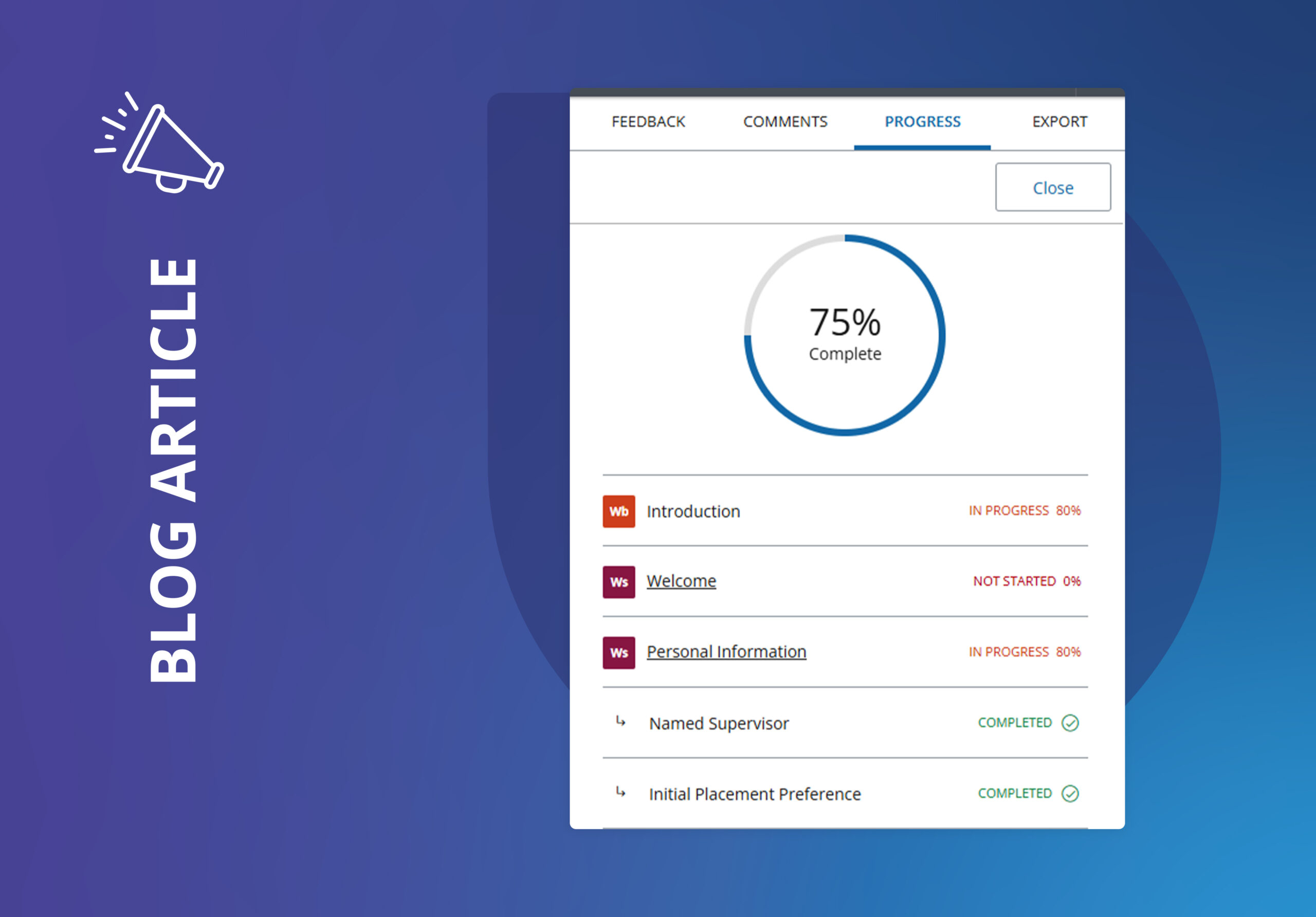
PebblePad has long supported placements, practicums, clinical rotations and work-integrated learning, where students record experiences, supervisors sign off and structured reflection connects each experience to the capacities it builds. Because faculty, advisors, careers staff and supervisors can all contribute to the same learner record, co-curricular growth sits alongside coursework. The whole person becomes visible, not just the transcript.
Technology with a human center
The report asks institutions to make technology use an intentional decision, guided by whether it strengthens relationships between students, faculty, and staff (pp. 53-54). It goes further, urging investment in technologies that fit a human-centered mission better than what is commercially available today (p. 54).
We read that as a fair challenge to every education technology provider, ourselves included. PebblePad was built for education from the start. It keeps faculty judgment and human feedback at the heart of assessment, and every portfolio is a record of conversations between learners and the people guiding them.
Learning that continues after graduation
Finally, the committee imagines degrees, master’s programs and continuing education as “points on a continuum” across a long career (p. 124) and suggests exploring a subscription model for lifelong learning (p. 139). A degree, it observes, now signals a strong foundation in a practice that will keep changing (p. 123).
A PebblePad portfolio does not end at graduation. Learners keep adding to their evidence of learning as alumni, returning students and working professionals, and institutions keep a lasting connection with the graduates they helped shape.
A question for the whole sector
Cornell’s committee is careful to say its recommendations are written for Cornell. But its diagnosis will be familiar to every provost, dean and assessment leader in the country: the credential alone no longer proves learning, AI has changed what assessment must look like, and students need their growth recognized wherever it happens.
PebblePad has spent over 20 years working with institutions on this: evidence of learning that employers can trust, assurance of learning that holds across programs, and a record that grows with the learner. If your institution is working through the same questions, we would welcome the conversation.
Read the full Cornell report: Future of the American University (PDF)
At a Glance: Cornell Themes and Implications
| Theme in the Cornell report | Pages | Where PebblePad Fits |
|---|---|---|
| AI-resilient assessment and reflection | 26, 44, 49 | Process-based evidence, embedded reflection, ATLAS assessment |
| Evidence of competence for employers | 29-30, 36-37 | Verifiable, CLR/LER-aligned skills record |
| Stackable, portable micro credentials | 140 | Evidence-backed credentials on shared infrastructure |
| Shared competency framework, local implementation | 57, 129 | Central frameworks, program-level templates, cross-program reporting |
| Tools to assess faculty public impact | 116 | Faculty portfolios for promotion and tenure |
| Whole-person and experiential learning | 44, 46, 49 | Placements, supervisor sign-off, shared learner record |
| Relationship-enhancing technology | 53-54 | Human feedback at the center of assessment |
| Lifelong learning continuum | 123-124, 139 | Portfolios that continue after graduation |