




Shane Sutherland reflects on a series of recent reports and the shared questions they raise about human judgement, educational purpose and making learning visible in an AI-integrated world.
What Recent Reports Have Me Thinking About
A lot of reports have crossed my desk(top) recently and I thought it might be worth collating some of my thoughts in somewhat of a stream of consciousness, reflective, personal aide memoir. It’s largely written for me, but maybe you’ll find it useful too.
As I moved between these reports, I found myself noticing less their differences and more the similarities between them. They address topics as varied as micro-credentials, academic integrity, artificial intelligence, assessment and student success, but all seem to be circling a common question: how do universities cultivate and assure meaningful learning in an increasingly complex world?
Signals from the Sector
The Pan-Canadian Report on Digital Learning Trends was of interest, partly because with so many Canadian customers we agreed to help sponsor the report to help us keep abreast of… trends in Canada. Amongst the many interesting findings in the report was the section on micro-credentials – an accreditation revolution that has never really hit its stride. Despite persistent expectations of growth, adoption remains uneven. Whilst I’m instinctively drawn to the idea, having started my teaching life immersed in competency-based education, I’ve never entirely resolved the tension between competence, competency and mastery.
Elsewhere in the report I was interested to be reading about the same ‘hygiene’ issues impacting on student success as we see elsewhere – affordability, access, transport and juggling work-life-study. Access to reasonable housing has been a widely reported issue in Canada, but like many HE-related issues it is increasingly trans-global.
Likewise, the top institutional challenges reported by the CDLRA could likely have been reported in any jurisdiction:
- Academic integrity (e.g., preventing plagiarism and cheating)
- Developing policies or guidelines for AI use
- Social and mental health supports for students
- Effective assessment practices (for online learning contexts)
At first glance these may appear to be separate concerns. Yet I increasingly see them as interconnected. Questions about academic integrity, assessment design and AI policy are ultimately questions about how institutions recognise, support and assure learning.
Beyond AI: A Question of Educational Purpose
What interested me most, however, was not the challenges themselves, but what they seem to reveal about the broader purpose of higher education.
The CDLRA report draws on the experiences of 126 participants in varied roles across 81 Canadian institutions, whereas the Cornell report The Future of the American University, is the work of a committee engaged in a year-long process, ‘including engagement with thousands of internal and external stakeholders across hundreds of meetings, activities, and events’ in a single institution. As its title suggests, it is positioned at a much more strategic, indeed, existential level, and whilst written to be relatable to other elite, American research universities, it seems to me that the challenges identified and the vision espoused would resonate with very many of the university leaders I am privileged to engage with across the globe. If CDLRA highlights operational challenges facing institutions today, Cornell’s Future of the American University asks a more fundamental question about what higher education exists to achieve.
Its authors argue:
“(We) must confront an uncertain future driven by a number of disruptors, notably including rapid technological change epitomized in the current moment by the rise of artificial intelligence (AI), fissures in the relationship between universities and the federal government, and the erosion of public trust in higher education.”
To a greater or lesser extent these disruptors are present everywhere I travel, but the one featuring in the greatest number of conversations is the first – the disruption of gen AI.
Depending on where and when you are reading, the disruption of AI is an issue of leadership and governance, but also of patchy policy and uneven policy adoption; it’s a matter of concern for faculty, and as such an issue best addressed through curriculum transformation (and adaptive capabilities, as explored in the TEQSA document). It also surfaces as the omnipresent spectre sowing fear and anxiety amongst students, often exacerbated by said ambiguous institutional policy and guidance, with the Wonkhe/Studiosity publication Keeping the learning real revealing a very mixed picture on AI adoption, with policies still in development and/or unevenly applied in institutions, lack of clarity about appropriate or permitted AI use in assessment, attempts to penalise students for academic misconduct based on patchy evidence and, consequently, real and significant stress for students.
Human-Centred Education and the Cultivation of Judgement
Back to the Cornell report. Its authors argue that at its best, the university is an integrated ecosystem for learning whose goal, in its broadest sense, is the cultivation of sound judgment – strong echoes of which I also encounter in the TEQSA paper Assuring quality learning in a gen AI-integrated future: The role of adaptive capabilities.
Having already excused myself that this is not an academic paper I feel quite at ease pasting large chunks of the reports I have read into my summary here. Partly because there are aspects so well written that I’m reluctant to para-hack them – but also because those bits I am direct quoting are the bits that resonated most strongly with me, and I want to include them unsullied. The Cornell authors write that:
The virtue of deliberation — fostered through rigorous scholarship, deep engagement with different perspectives, careful discovery and consideration of evidence, questioning of one’s assumptions, open and in-depth dialogue, and intellectual humility — is central to learning and cultivating sound judgment.
They lament the fragmentation of learning experiences across an institution. They argue that while there are many ways in which the learning experiences of today are richer and more varied than ever, they are also more siloed. An increasing student dependence on technology and social media can have a further splintering effect that may lead to isolation and lack of robust connection… that the gaps that separate different forms of learning in the university are widening, weakening higher education’s value proposition.
Whilst articulated better than I have ever managed, I immediately recognise the trace of many talks I have given over the years, an ambition to promote whole-person education.
The goal of education is not merely the transfer of knowledge, but the development of socially connected, emotionally resilient, and civically minded graduates who are comfortable navigating uncertainty, and are able to leverage knowledge and sound judgment to produce constructive solutions to complex problems. These capacities are not produced through knowledge alone; they require personal growth and transformation.
The Future of the American University relies on a clear purpose – a human-centered, integrated learning ecosystem to cultivate sound judgment. It aligns very neatly with Principle 1 ‘Human-centred education’ as articulated in the Australian Framework for Artificial Intelligence in Higher Education.
Human-centred education. How radical! For years I talked about learning-centric design, until the very wise Gary Brown (WSU and AAEEBL) helped me extend my thinking and speaking to include the learner and the learning. Unsurprisingly I like human-centric as a core principle.
What resonates most strongly for me is that the conversation is shifting from knowledge acquisition toward capability development. The challenge is no longer simply what students know, but how they think, adapt, reflect and exercise judgement.
Adaptive Capability in an AI-Integrated World
The similarities and sympathies between the Cornell FAU report and the TEQSA document are striking. In the TEQSA document we read:
“In the age of gen AI, higher education must shift its focus beyond transmitting knowledge to fostering students’ ability to regulate their learning and thinking within complex networks of human-gen AI interaction, building on deep disciplinary knowledge.”
They argue that gen AI is “augmenting, not replacing, work” and is actively “lifting demand for digital literacy and ‘human’ skills” using this to argue for the recognition of adaptive capabilities as core graduate attributes.
They define adaptive capabilities as the high-level, integrated capacities that enable graduates to navigate complex, novel and gen AI-integrated environments. These capabilities empower individuals to deploy, adapt and transfer their specific, demonstrable skills effectively and ethically. Underpinning these 4 capabilities are agency and regulation — the human capacity to plan, monitor, evaluate and adjust one’s learning and decision-making across diverse contexts. Combine that with the purpose espoused by Cornell and, it seems to me, we’re approaching a grand vision for HigherEd.
I really liked what I guess is the rationale for the agency and (self) regulation piece, which posits that when students use gen AI to obtain simplified explanations, they may mistake surface-level comprehension for the deeper understanding expected in higher education. The ability of gen AI to present complex ideas in a straightforward manner can lead to overconfidence, stemming from the fluent presentation. I particularly like their inclusion of Desirable difficulties: The value of productive struggle.
Many of us have long argued that learning should be demanding, sometimes discombobulating, stretching, discomforting. Maybe, in my mind, it’s only when you work hard for something do you see the true value in it. My biggest fears with gen AI remain centred around the idea of outsourcing some of the effort that thinking (reflecting, analysing, imagining) requires. The trade-off between ease and value beautifully captured by this, my new favourite subtitle – Desirable difficulties: The value of productive struggle.
This is perhaps where I find the strongest point of convergence across all of the reports. They are not arguing against AI. Rather, they are reminding us that learning requires effort, reflection, uncertainty and growth. These remain fundamentally human experiences.
Evidencing the Learning Process
For me, this is where many of the themes raised across these reports begin to converge. If universities wish to develop human judgement, adaptive capability and authentic learning in an AI-enabled world, then they need ways to make learning processes visible rather than focusing solely on learning products.
The TEQSA document considers in depth the fourth of the challenges listed in the CDLRA report i.e. transforming assessment practices in the age of gen AI, with its authors asserting that assessment transformation represents the most immediate opportunity for progress toward their goals as process-focused evaluation aligns naturally with adaptive capabilities development.
Rather than replacing traditional assessment outputs, process-focused evaluation involves rebalancing assessment so that evidence of learning processes sits alongside assessment products, enabling educators to capture how students plan, monitor, evaluate and adapt their thinking over time. I imagine that pretty much all of the PebblePad community reading this will be nodding in enthusiastic approval (or head-in-hands a voice inside you will shout OBVIOUSLY!)
Any seasoned PebblePad user could have written what follows:
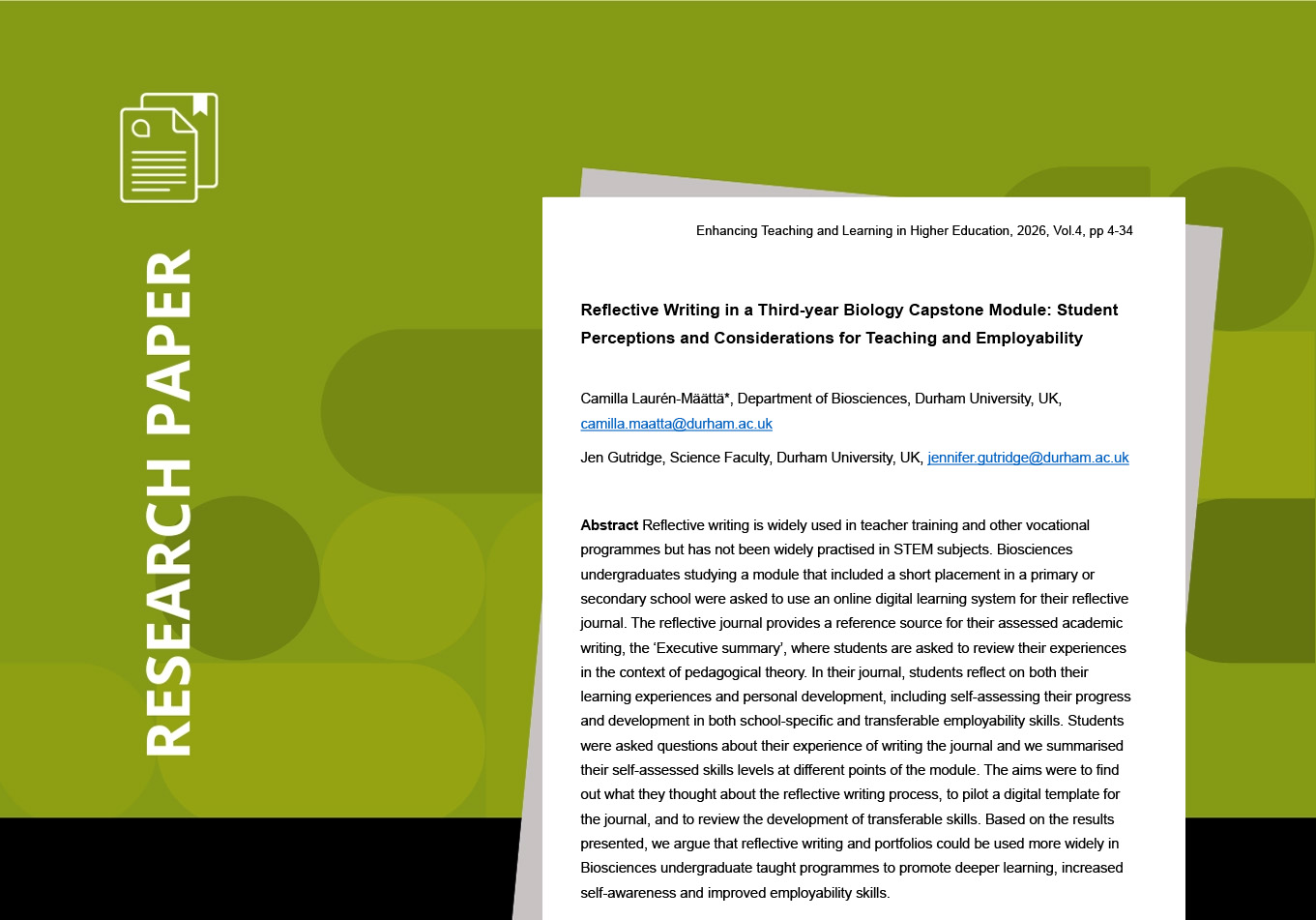
Process-focused evaluation includes approaches that foreground learning journeys, portfolio-based evaluation and reflective practices that make students’ regulatory capabilities visible e.g. assessment capturing learning journeys, portfolios showing development over time, reflective practices demonstrating metacognitive growth.
Looking Forward
So, how to summarise. Universities worldwide are facing significant challenges exacerbated, amplified or hastened by gen AI. There is a need, and increasingly it seems, a desire to move beyond content and courses, to learner- and learning-centric higher education; a more human-centred approach. We must develop the human capacity to plan, monitor, evaluate and adjust one’s learning and decision-making across diverse contexts – and cultivate sound judgment. I’ve spoken often about planning and preparing for learning being essential pre-requisites for noticing what is being experienced and learned. What is noticed must also be recorded and reflected upon so that those attributes, skills, and adaptive capabilities are captured and developed over time – and ultimately articulated confidently, and deployed thoughtfully.
The ubiquity of gen AI means that it should not be excluded from learning, teaching or assessment, but what is acceptable needs to be guided by clear, fair and evenly applied policy. The main takeaway for me is that its use is likely but one part of the process of learning, and whereas in the past we have paid too little regard to the process, in favour of the product, the disruption of gen AI is forcing us to look long and hard at how we review, assess and assure learning. The more reports I read, the more convinced I become that the future of higher education will not be defined by artificial intelligence itself, but by how effectively institutions help learners develop judgement, agency, adaptability and purpose. The challenge before us is not simply accommodating AI, but ensuring that learning remains visible, meaningful and human.
For those of us who have long advocated reflection, portfolios, learning journeys and evidence of growth, it is encouraging to see these themes increasingly reflected in sector thinking. Perhaps the disruption of AI is not pulling us away from good educational practice, but reminding us of why it matters so much.