



Published Paper Title
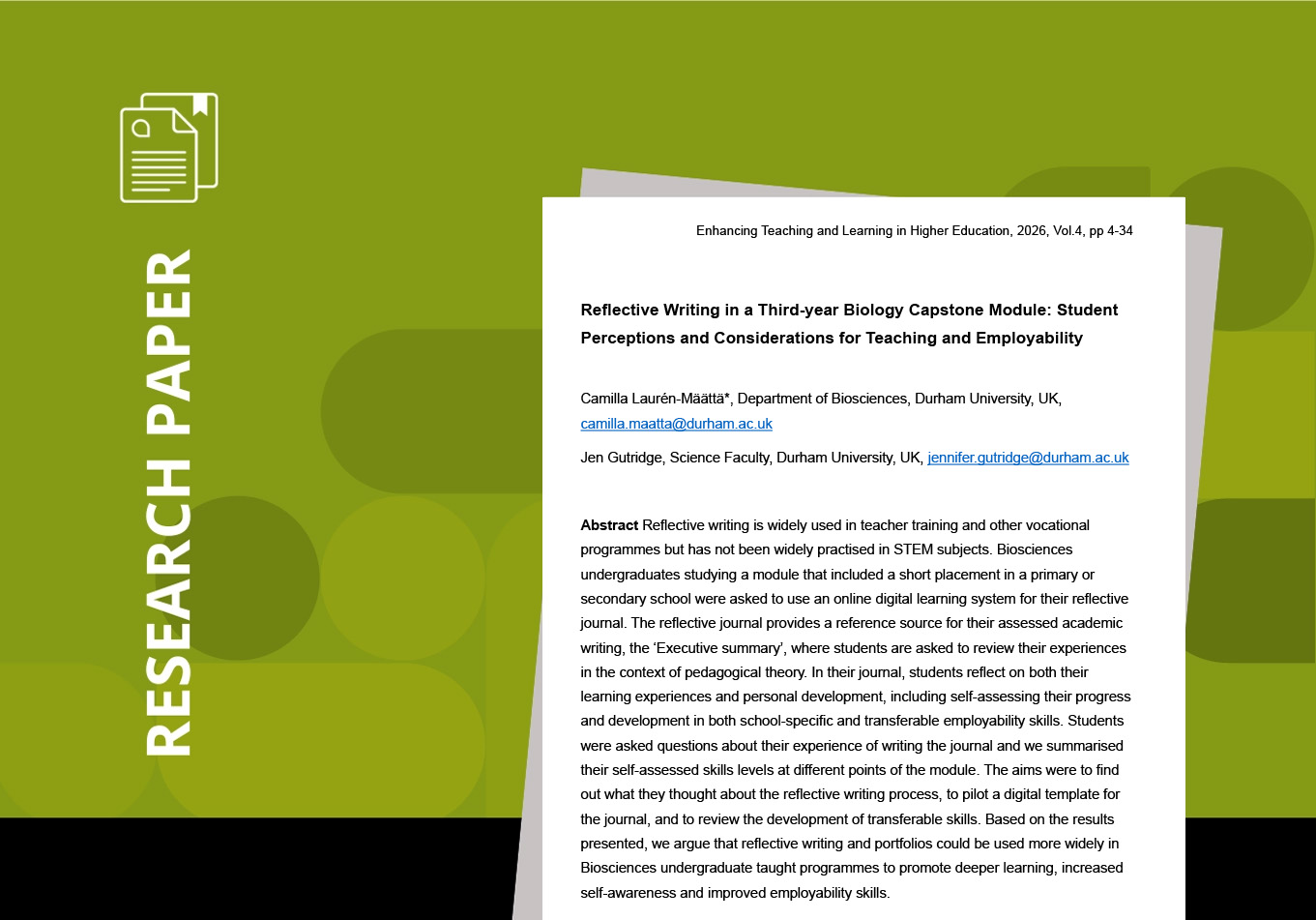
Reflective Writing in a Third-year Biology Capstone Module: Student Perceptions and Considerations for Teaching and Employability
Authors
Camilla Lauren-Maatta
Assistant Professor, Department of Biosciences, Durham University
Jen Gutridge
Digital Learning Developer, Science Faculty Office, Durham University
Published
Enhancing Teaching and Learning in Higher Education
DOI: https://doi.org/10.62512/etlhe.33
Summary
Reflective writing is widely embedded within teacher training and other vocational disciplines, helping students connect experiences with personal and professional development. This study explores how reflective practice can benefit Biosciences undergraduates undertaking a capstone module that included a short placement in a primary or secondary school.
Using PebblePad as a digital learning system, students maintained an online reflective journal throughout the module. The journal encouraged students to consider both their learning experiences and personal growth, while also evaluating their progress in key employability and transferable skills. These reflections then informed an assessed academic piece, the Executive Summary, where students analysed their experiences through the lens of pedagogical theory.
The study gathered student feedback on the reflective writing process and examined how students assessed their skills development at different stages of the module. Findings showed that while reflective writing can initially feel unfamiliar and challenging, particularly for science students, appropriate guidance and support helped students recognise its value.
Students reported benefits including greater self-awareness, deeper engagement with their learning, and improved understanding of their own skill development. Many also felt that reflective writing could have wider applications across Biosciences programmes beyond placement-based modules.
The authors argue that reflective writing and portfolio-based approaches have significant potential within undergraduate Biosciences education. By encouraging students to critically evaluate their experiences and evidence their development, these approaches can support deeper learning, strengthen employability skills, and better prepare graduates for future professional practice.