Search
Wednesday 26th October 2022

New graduate employment regulations from the UK OfS

Category: Articles
JodiePebblePad
by: Jodie Young

The UK OfS (Office for Students) recently announced new regulations which will see UK universities face sanctions if not enough graduates secure employment within 15 months of completing their studies. If you haven’t seen the news yet, let us break it down for you:

  • Condition B3 of the OfS’s regulatory framework means that universities could be fined up to £500,000 if 60% of graduates in a particular subject fail to find ‘high quality’ work, set up their own business or continue their studies after completing their courses.
  • What constitutes high quality? Well, different thresholds will be set for different courses “depending on their mode and level of study”, for example whether a student is studying part time, an apprenticeship or at a postgraduate level. This has made the regulation particularly controversial, and many see the thresholds as subjective.
  • Colleges and universities could also be fined for high dropout rates.

In light of the new regulations, universities up and down the country will undoubtedly be reflecting on their current employability strategies and evaluating what else they could be doing to help graduates secure suitable jobs.

So, what do we think? How can universities ensure employment success for its students? And how can we, at PebblePad help ensure universities have the right tools in place for success?

Helping create adaptable graduates

One of the main issues is that the world of work is so unpredictable. Experts at the World Economic Forum perfectly captured the zeitgeist when they claimed that universities have to educate young people for jobs that haven’t yet been invented. Automation, AI, and rapid digitalisation are changing the knowledge and skills needed to perform many jobs and fundamentally reshaping others.

Maybe that’s why our own Careers Readiness report showed that more than three in ten (34%) of students say they don’t know what skills they need for the workplace.

For many, the answer to this unpredictability is to prioritise softer skills – such as critical thinking, collaboration and problem solving – those transferable attributes which ensure students are able to adapt to the quick pace of change. We believe this is critical, and there’s plenty of great work going on in this arena already. A great example is The University of Bedfordshire, who has harnessed PebblePad to develop an inter-institution programme helping students work with peers around the world, and develop rich collaboration skills.
 

Tackling a skills articulation gap

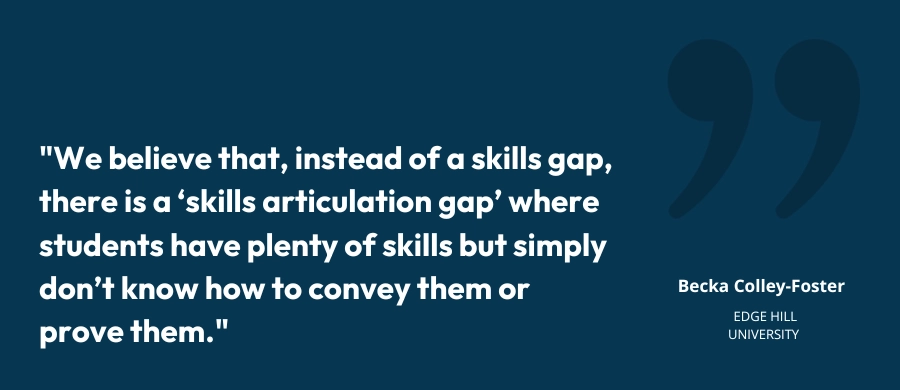
It’s nearly impossible to discuss employment and graduate outcomes without tackling the ‘skills gap’ which has plagued the business world for nearly a decade. However, we believe that, instead of a skills gap, there is a ‘skills articulation gap’ where students have plenty of skills but simply don’t know how to convey them or prove them.

To help address this urgent need, more focus needs to be put on helping students not just build the skills they need for employment but have opportunities to gather evidence and articulate their skills too. Eportfolio tools like PebblePad can help to provide those opportunities, enabling students to gather a range of evidence against a range of competencies, and rehearse the presentation of those skills to an audience. This means students gain confidence in the skills they have and their presentation of them too – critical stuff.


A rigorous approach to assessment

Building a hard-working assessment engine is of course critical to career success – identifying where a student is excelling, where gaps exist, and ensuring early intervention if a student is struggling with a crucial aspect of their course.

However, to boost students’ confidence, we believe that universities must also be committed to identifying and reflecting on students’ own perceptions of whether they have the skills and knowledge needed for employment. This not only means allowing students themselves time to reflect on and assess skills built, but to be actively involved in helping students assess how ready for employment they feel.


Learn more and turn intention into action

Becka-Colley Foster, Head of Careers at Edge Hill University is a renowned thought-leader on student outcomes and the importance of being able to evidence and articulate the skills and attributes needed for work. The great news is that she joined the team at PebblePad to host a webinar for anyone responsible for career readiness and graduate outcomes. The informative session took place on 2nd November, for anyone who missed it and are looking for practical tips on how to boost employability and help students secure and evidence their knowledge and attributes, check out the webinars page.

share
Picture of Jodie Young
Jodie Young

Meet Jodie, our Head of Customer Success in the APAC region. With a passion for education and a knack for crafting compelling narratives, she brings a wealth of knowledge on all things PebblePad. Jodie is your go-to guide for insights, tips, and inspiration.

Latest Articles

Want to chat

If you want to talk to a team who really understands
your world, please get in touch today.

Curriculum Transformation at the University of Edinburgh: co-creation and the relationship between local innovation and institutional change

Talk description: I will use the themes of reflection and experiential learning, skills development and assessment (including programme level assessment and changes in assessment practice) to explore this process in more detail. This includes the link between disciplinary and institutional curriculum reform, learning from local innovations and changes, and using this to inform University level changes and support.

Bio: My current position is leading the University wide Curriculum Transformation Project. This is a major and long term initiative for the University considering all areas of the University’s undergraduate and taught postgraduate curriculum. Prior to this Jon set up and led the Institute for Academic Development (IAD) at the University of Edinburgh. The IAD provides University level support for teaching, learning and researcher development, including direct support for students and staff, and support for enhancement and innovation in curriculum development, the student and researcher experience. Jon has a PhD in petroleum geology.

Mission Possible: The DNA of a bespoke professional development program

Talk description: The diversity of students in higher education dictates that there cannot (and should not) be a single ‘silver bullet’ approach to address the complex challenge of career readiness learning. However, the reality of modern university structures is that delivering bespoke experiences for each student is a challenge in and of itself.  And yet, all things are possible with creative use of PebblePad to streamline delivery (for the university) and make it highly personalised (for the student). 

Bio: Gayle Brent is a Learning and Teaching Consultant (Employability) at Griffith University, Queensland, Australia. Gaye’s specialist area of interest is developing and implementing strategies to enhance staff and student understanding of employability in both curricular and extra-curricular contexts. She completed a Master of Education and Professional Studies Research to explore the potential barriers and challenges to embedding employability-based learning in higher education curriculum and is currently completing a Doctor of Philosophy exploring the impact of an extra-curricular employability program on the individual student experience.

Dr Melissa Highton. Assistant Principal, University of Edinburgh

Talk description: A journey through the stories told by wicca data. How a neglected research data set was used by students to overturn historic injustice and shed new light on the lives of women in Scotland.

Bio: Melissa has worked for many years in higher education at some of the UK’s finest and most ancient institutions. In each place she enjoys discovering the hidden histories and less heard voices which can be surfaced in new ways using the most up to date and open technologies. She is a champion of playful and curious approaches to engagement with audiences on campus and online, and is an invited speaker at events about dangerous women.

Education is an Experience That Should Be Designed

Talk description: We have any number of problems and opportunities as universities, and universities must adapt to help students from diverse backgrounds develop the knowledge and skills they need to thrive and make a positive impact in the world. Key to those adaptations is understanding that we provide students with an experience. We ought to design them with intention and purpose. This talk with take up this argument and ground it within a large educational transformation project at the University of Leeds.

Bio: Jeff Grabill is Deputy Vice Chancellor for Student Education at the University of Leeds. Prior to joining the University of Leeds, Grabill was at Michigan State University (MSU) in the United States for nearly 20 years. He served Michigan State University as the Associate Provost for Teaching, Learning, and Technology. In that role, he was responsible for facilitating innovation in learning and educator professional development via his role as Director of the Hub for Innovation in Learning and Technology. Grabill’s research focuses on how digital writing is associated with citizenship and learning. That work has been located in community contexts, in museums, and in classrooms at both the K-12 and university levels. Grabill is also a co-founder of Drawbridge, an educational technology company.

Sign Up to the Customer Newsletter