Search
Sunday 12th November 2023

Empowering graduates: enhancing career readiness

Category: Company
Full colour iconPebblePad@2x
by: PebblePad

Alison Poot, Senior Director, Global Customer Success and APAC at PebblePad, recently hosted an insightful webinar on career readiness, drawing more 260 participants from around the world and featuring a distinguished panel of experts in the field of higher education from across Australia:

  • Professor Sally Kift, President of the Australian Learning and Teaching Fellows (ALTF), Vice Chancellor’s Fellow at Victoria University, and Adjunct Professor at JCY, QUT, and La Trobe University.
  • Gayle Brent, Senior Fellow at the Higher Education Academy (SFHA) and Learning and Teaching Consultant in Sciences at Griffith University.
  • Professor Michael Sankey, Director of Learning Futures and Lead Education Architect at Charles Darwin University.

This webinar marked the beginning of an exciting series focused on preparing students for the future, with forthcoming sessions featuring experts from the United States and the United Kingdom.

Professor Michael Sankey raised a critical question: While we excel at incorporating these strategies in individual lectures, how well are they connected on a broader scale? Michael suggests that there’s room for a collective dialogue across an institution – bringing in all aspects of a course, but widely across the academic community to ensure a more cohesive and coordinated approach.

In addressing this challenge, Michael underscores the need for universities to act as holistic ecosystems.
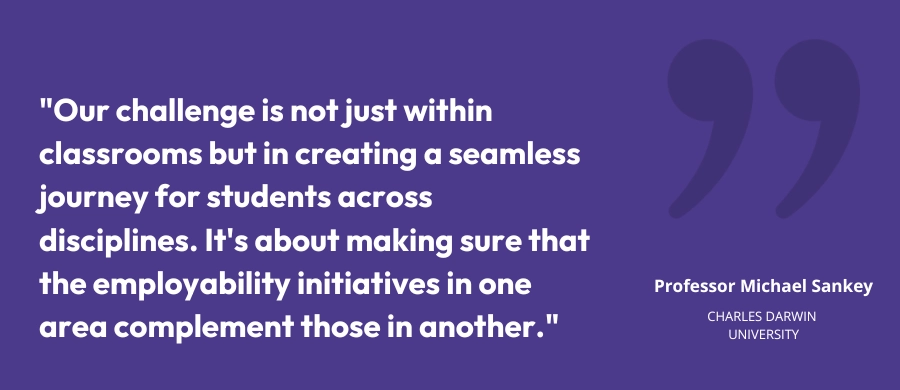
Michael highlights the instrumental role of ePortfolios in this alignment. Unlike isolated assessments, ePortfolios operate on a programmatic level, providing a comprehensive view of a student’s educational journey. They act as a guiding mechanism, leading students towards a well-defined destination by integrating various elements of their learning experiences. Essentially, ePortfolios serve as a tool that not only assesses individual components but also weaves them together, fostering a more integrated and seamless educational experience. In this way, they contribute to bridging the gap between disparate lectures and creating a more joined-up educational landscape.

Development of a skills passport

The discussion also delved into a national initiative in Australia: the development of a “skills passport” which aims to address the country’s skills shortage. This digital passport is set to provide irrefutable evidence of a worker’s qualifications and abilities.

Sally views the skills passport as a positive stride forward, stating, “It represents a step in the right direction and serves as an impetus for all stakeholders to work together. The acknowledgment of the importance of lifelong learning and upskilling aligns with our goal of preparing graduates for the evolving landscape of the labour market.”

Michael also emphasises the crucial role of engaging with industry. He reminded the audience that we need to ensure that our curriculum is aligned with industry needs. It’s not just about teaching; it’s about teaching the right things – and while the skills passport is a practical step towards this alignment, ensuring that what we teach directly translates into valuable, in-demand skills in the workforce is imperative.

This industry-wide approach signifies a holistic strategy, where government, education institutions, and industry collaborate to not only bridge skill gaps but also promote inclusivity and address societal challenges such as gender inequality and the need for support mechanisms for older workers returning to the workforce.

A hard road ahead

In wrapping up our discussion, everyone agreed: making employability a core part of education is no walk in the park. It’s a huge task that needs a detailed plan weaving through every course and aspect of education. It’s not an easy road, but it’s a crucial one to get students ready for today’s world.

We really enjoyed this lively and informative discussion. This blog covers just some of the topics discussed – to delve deeper into these critical discussions, we invite you to explore the complete recording. It covers essential aspects of shaping education for the future, providing valuable insights into the ongoing efforts to better equip students for their careers.

And of course, all of this needs to be considered against the backdrop of a rapidly evolving tech landscape, where educators are working out how tools like AI affect their ability to boost career readiness.

As Gail puts it, “with AI there are more opportunities than threats, in terms of career development, authentic assessment and programmatic design.” She says, “It’s important we proactively start to use AI in education, as we know today’s students will be using these tools in the workplace and if we don’t encourage them to harness AI in an ethical way, using their critical thinking prowess, we simply won’t be setting up for success!”
share
Picture of PebblePad
PebblePad

Latest Articles

Want to chat

If you want to talk to a team who really understands
your world, please get in touch today.

Curriculum Transformation at the University of Edinburgh: co-creation and the relationship between local innovation and institutional change

Talk description: I will use the themes of reflection and experiential learning, skills development and assessment (including programme level assessment and changes in assessment practice) to explore this process in more detail. This includes the link between disciplinary and institutional curriculum reform, learning from local innovations and changes, and using this to inform University level changes and support.

Bio: My current position is leading the University wide Curriculum Transformation Project. This is a major and long term initiative for the University considering all areas of the University’s undergraduate and taught postgraduate curriculum. Prior to this Jon set up and led the Institute for Academic Development (IAD) at the University of Edinburgh. The IAD provides University level support for teaching, learning and researcher development, including direct support for students and staff, and support for enhancement and innovation in curriculum development, the student and researcher experience. Jon has a PhD in petroleum geology.

Mission Possible: The DNA of a bespoke professional development program

Talk description: The diversity of students in higher education dictates that there cannot (and should not) be a single ‘silver bullet’ approach to address the complex challenge of career readiness learning. However, the reality of modern university structures is that delivering bespoke experiences for each student is a challenge in and of itself.  And yet, all things are possible with creative use of PebblePad to streamline delivery (for the university) and make it highly personalised (for the student). 

Bio: Gayle Brent is a Learning and Teaching Consultant (Employability) at Griffith University, Queensland, Australia. Gaye’s specialist area of interest is developing and implementing strategies to enhance staff and student understanding of employability in both curricular and extra-curricular contexts. She completed a Master of Education and Professional Studies Research to explore the potential barriers and challenges to embedding employability-based learning in higher education curriculum and is currently completing a Doctor of Philosophy exploring the impact of an extra-curricular employability program on the individual student experience.

Dr Melissa Highton. Assistant Principal, University of Edinburgh

Talk description: A journey through the stories told by wicca data. How a neglected research data set was used by students to overturn historic injustice and shed new light on the lives of women in Scotland.

Bio: Melissa has worked for many years in higher education at some of the UK’s finest and most ancient institutions. In each place she enjoys discovering the hidden histories and less heard voices which can be surfaced in new ways using the most up to date and open technologies. She is a champion of playful and curious approaches to engagement with audiences on campus and online, and is an invited speaker at events about dangerous women.

Education is an Experience That Should Be Designed

Talk description: We have any number of problems and opportunities as universities, and universities must adapt to help students from diverse backgrounds develop the knowledge and skills they need to thrive and make a positive impact in the world. Key to those adaptations is understanding that we provide students with an experience. We ought to design them with intention and purpose. This talk with take up this argument and ground it within a large educational transformation project at the University of Leeds.

Bio: Jeff Grabill is Deputy Vice Chancellor for Student Education at the University of Leeds. Prior to joining the University of Leeds, Grabill was at Michigan State University (MSU) in the United States for nearly 20 years. He served Michigan State University as the Associate Provost for Teaching, Learning, and Technology. In that role, he was responsible for facilitating innovation in learning and educator professional development via his role as Director of the Hub for Innovation in Learning and Technology. Grabill’s research focuses on how digital writing is associated with citizenship and learning. That work has been located in community contexts, in museums, and in classrooms at both the K-12 and university levels. Grabill is also a co-founder of Drawbridge, an educational technology company.

Sign Up to the Customer Newsletter