

Search
Monday 30th October 2023

Introducing our new Rich Content Editor

Category: Product
Full colour iconPebblePad@2x
by: PebblePad

At PebblePad, we’re always looking for ways to improve our platform and deliver the best possible experience for our users. Over the last few years, we have committed to a monthly product release, full of improvements to delight customers and drive our product forward.

This month we are pleased to announce that after much anticipation, our new Rich Content Editor (RCE) is now live for all customers. This updated feature retains all the familiar functionality and features users expect from a content editor, including text formatting, styling and linking, as well as some highly requested new features.

Read on to discover the key benefits and improvements that come with this upgrade.

Enhanced compatibility

At PebblePad, we are committed to improving accessibility and preparing our platform for future updates and further enhancements. That’s why we’re delighted to announce that our RCE is now accessible on iOS devices, as well as desktop and Android.

To ensure a seamless experience, we’ve set minimum browser and operating system (OS) versions:

  • Google Chrome 107 (and above)
  • Mozilla Firefox 107 (and above)
  • Microsoft Edge 107 (and above)
  • Opera 95 (and above)
  • Safari 14 (and above)
  • iOS/iPadOS 14 (and above)
  • Android 10 (and above)

A new look and location

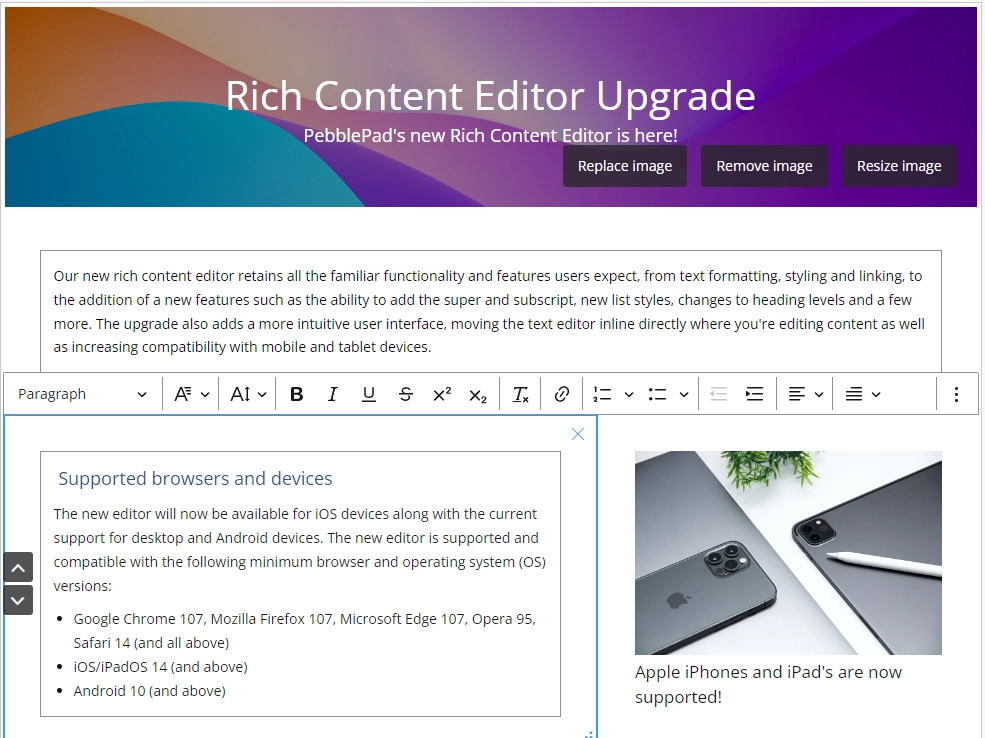
One of the most noticeable changes in this update is the location of our new inline toolbar. The toolbar location changes depending on where you’re working within the platform, so now it’s right where you need it, making it easier for you to edit and style your content throughout Pebble+ and Submission Viewer 2.

We’ve also changed the look and feel of our toolbar and introduced a better responsive design for smaller screens and devices. If you can’t find what you’re looking for on the inline editor toolbar, then not to worry. You can access additional functionality by opening the three-dot “Show more items” overflow menu located on the far right.
Total control of your content

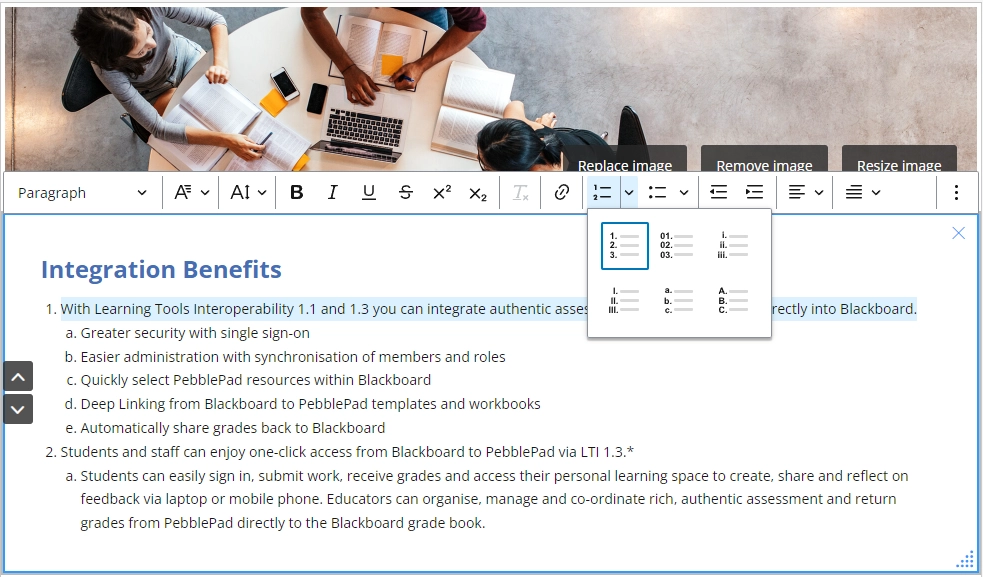
Are you looking for more and better ways to organise your content? Our new RCE introduces seven new sets of unordered and ordered list styles, giving you better flexibility when laying out and structuring content. You can even customise nested lists to match your preferred style.
Subscript and superscript features

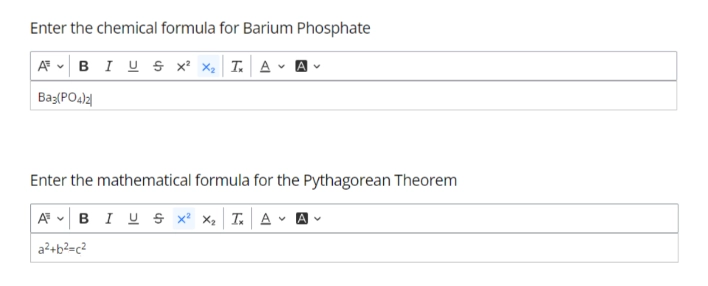
Does your work include scientific or mathematical formulas? If so, you’re in for a treat. We’ve added sub and superscript features to the new RCE, allowing you to present simple formulae and equations in the correct format.
Heading level and accessibility updates

Want to make your content more consistent? We’ve updated the paragraph and heading drop-down menu to include a more accessible and logically organised heading level hierarchy. This automatically updates based on your Asset/Resource layout, ensuring consistency throughout your content.
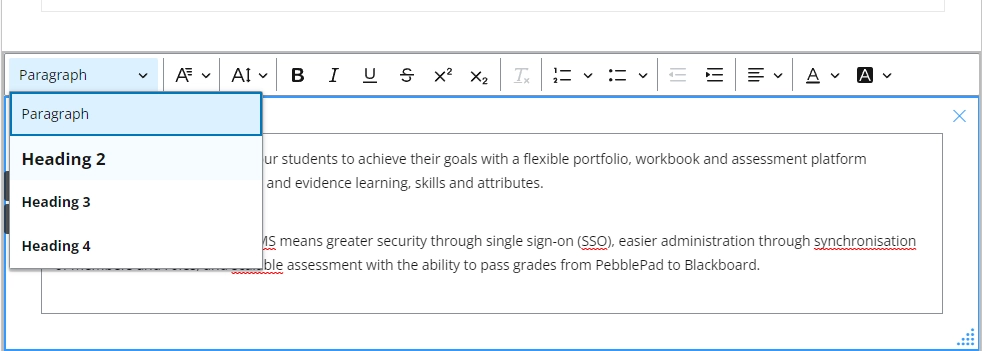
We’ve also improved the RCE’s accessibility by adding a help prompt for screen-readers. Users can now use the Alt+F10 (for Windows) or Option+F10 (for Mac) commands to easily access the toolbar, making content creation more inclusive.

Hyperlinking made easier

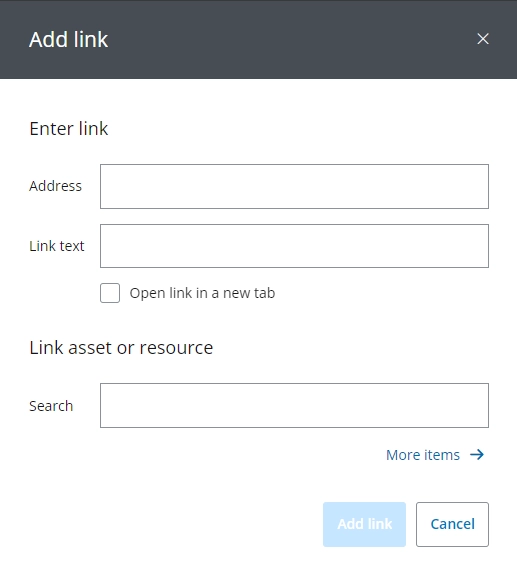
Adding evidence and linking to resources is now a breeze with the new RCE. Our new updated modal allows you to add, edit and delete both your original link and the link text, making it easier to manage links to evidence and resource materials. You can also find recent assets and resources to attach using our quick search, saving time and energy.
What’s next?

We’re always looking for ways to improve our platform so keep your eyes peeled for some exciting updates due for release at the end of next month.

For a full list of all the changes made in October (and this year so far), check out our product release notes below.


VIEW RELEASE NOTES

share
Picture of PebblePad
PebblePad

Latest Articles

Want to chat

If you want to talk to a team who really understands
your world, please get in touch today.

Curriculum Transformation at the University of Edinburgh: co-creation and the relationship between local innovation and institutional change

Talk description: I will use the themes of reflection and experiential learning, skills development and assessment (including programme level assessment and changes in assessment practice) to explore this process in more detail. This includes the link between disciplinary and institutional curriculum reform, learning from local innovations and changes, and using this to inform University level changes and support.

Bio: My current position is leading the University wide Curriculum Transformation Project. This is a major and long term initiative for the University considering all areas of the University’s undergraduate and taught postgraduate curriculum. Prior to this Jon set up and led the Institute for Academic Development (IAD) at the University of Edinburgh. The IAD provides University level support for teaching, learning and researcher development, including direct support for students and staff, and support for enhancement and innovation in curriculum development, the student and researcher experience. Jon has a PhD in petroleum geology.

Mission Possible: The DNA of a bespoke professional development program

Talk description: The diversity of students in higher education dictates that there cannot (and should not) be a single ‘silver bullet’ approach to address the complex challenge of career readiness learning. However, the reality of modern university structures is that delivering bespoke experiences for each student is a challenge in and of itself.  And yet, all things are possible with creative use of PebblePad to streamline delivery (for the university) and make it highly personalised (for the student). 

Bio: Gayle Brent is a Learning and Teaching Consultant (Employability) at Griffith University, Queensland, Australia. Gaye’s specialist area of interest is developing and implementing strategies to enhance staff and student understanding of employability in both curricular and extra-curricular contexts. She completed a Master of Education and Professional Studies Research to explore the potential barriers and challenges to embedding employability-based learning in higher education curriculum and is currently completing a Doctor of Philosophy exploring the impact of an extra-curricular employability program on the individual student experience.

Dr Melissa Highton. Assistant Principal, University of Edinburgh

Talk description: A journey through the stories told by wicca data. How a neglected research data set was used by students to overturn historic injustice and shed new light on the lives of women in Scotland.

Bio: Melissa has worked for many years in higher education at some of the UK’s finest and most ancient institutions. In each place she enjoys discovering the hidden histories and less heard voices which can be surfaced in new ways using the most up to date and open technologies. She is a champion of playful and curious approaches to engagement with audiences on campus and online, and is an invited speaker at events about dangerous women.

Education is an Experience That Should Be Designed

Talk description: We have any number of problems and opportunities as universities, and universities must adapt to help students from diverse backgrounds develop the knowledge and skills they need to thrive and make a positive impact in the world. Key to those adaptations is understanding that we provide students with an experience. We ought to design them with intention and purpose. This talk with take up this argument and ground it within a large educational transformation project at the University of Leeds.

Bio: Jeff Grabill is Deputy Vice Chancellor for Student Education at the University of Leeds. Prior to joining the University of Leeds, Grabill was at Michigan State University (MSU) in the United States for nearly 20 years. He served Michigan State University as the Associate Provost for Teaching, Learning, and Technology. In that role, he was responsible for facilitating innovation in learning and educator professional development via his role as Director of the Hub for Innovation in Learning and Technology. Grabill’s research focuses on how digital writing is associated with citizenship and learning. That work has been located in community contexts, in museums, and in classrooms at both the K-12 and university levels. Grabill is also a co-founder of Drawbridge, an educational technology company.

Sign Up to the Customer Newsletter