

Learn how a whole‑institution framework is reshaping student confidence, capability and readiness for an uncertain world of work.
Recently, PebblePad hosted the webinar ‘Transforming Graduate Employability Using a Future Skills Framework’. This brought together Kingston University’s Director of Student Development Ali Orr and Director of Learning & Teaching Becky Lees to unpack one of the most ambitious whole‑institution skills initiatives ever seen in the sector.
Across an hour of insightful conversation – guided by PebblePad’s Chief Academic Officer Shane Sutherland – the session explored how Kingston is reshaping student readiness for a world where job roles evolve quickly, technologies can shift overnight and learners need more than discipline knowledge to secure their future career.
More than ‘just’ skill
The webinar spotlighted how Kingston’s innovative framework enables students not only to develop future skills, but to recognise, articulate and build on them through scaffolded learning, reflective workbooks and a “tool that travels” with them from enrolment to graduation. What emerged was far more than a story about employability; it was a story about identity, belonging and confidence, and the transformative impact of helping students understand who they are becoming.
As Shane reminded attendees at the outset, PebblePad was created to support exactly this kind of learning journey, “to help students make sense of their learning, to notice skills they are developing, to evidence them where necessary, and most importantly, to be able to speak confidently to what skills they had and who they were becoming.”
And this philosophy – focused less on content acquisition and more on identity, trajectory and self‑understanding – runs through every part of Kingston’s framework-based approach.
But why future skills – and why now?
For Ali Orr, Director of Student Development, the answer begins with understanding Kingston’s learners, which is a diverse community with many commuting, the first in their families to enter higher education, arriving through non‑traditional qualification routes – or all three. “One of the questions that we have asked ourselves for a long time,” recalled Ali, “[is] how can we ensure that access participation and student inclusion … translate into graduate capital and translates into really positive outcomes for our students?”
To begin answering this important question, in 2021, Kingston partnered with YouGov to explore the UK’s future skills landscape, surveying over 2,000 businesses to understand what their future skills needs were in graduates. The findings echoed what employers across sectors have stated for years with human‑centric skills consistently topping the list of desired graduate attributes. The insights gleaned from the research went on to become Kingston’s nine defined Future Skills attributes:
Creative problem solving • Digital competency • Being enterprising • Having a questioning mindset • Adaptability • Empathy • Collaboration • Resilience • Self‑awareness
![“[Since the survey was conducted and] with the advent of generative AI … we’re all aware that the need for human-centric skills has only grown in … importance over that time.” Ali Orr, Director of Student Development, Kingston University](https://pebblepad.com/wp-content/uploads/2026/03/Kingston1-scaled.png)
Transforming programmes
The nine Future Skills attributes formed the centrepiece of Kingston’s new university strategy, announced shortly after the research in 2022. As Ali explained in the webinar, the strategy placed Future Skills “at the absolute heart of it.”
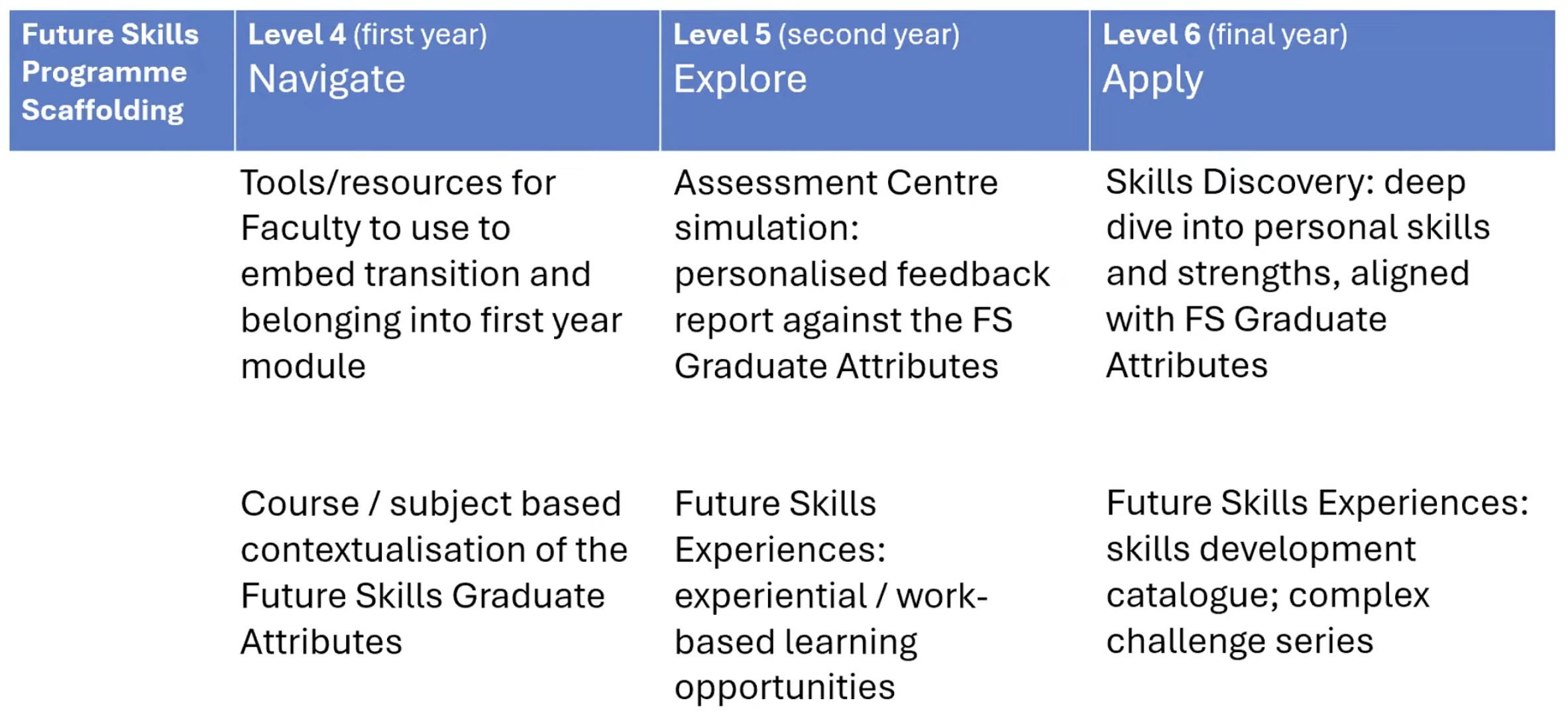
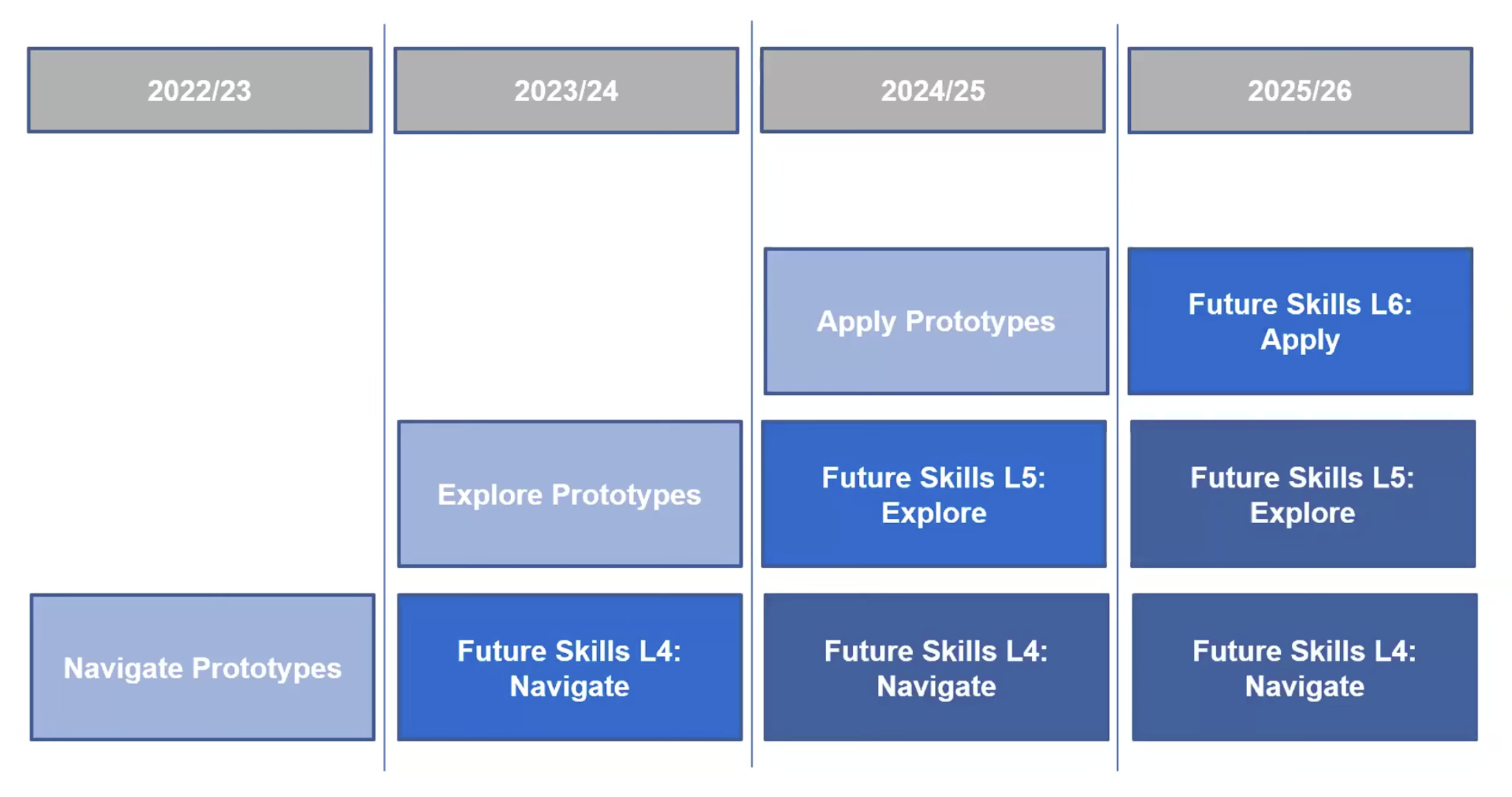
This signalled a whole‑institution shift, designed to ensure every single student benefited from the same consistent, research‑informed skills development – no matter the programme – with the framework moving all students through three phases across the three years:
Navigate
Building foundational self‑awareness
Explore
Applying skills and analysing feedback
Apply
Articulating strengths, ambitions and direction
Ali described the framework’s journey as “reflecting, refining and tailoring [students’] skills to their career ambitions,” a process of scaffolding that ensures consistency without ever flattening individuality.
As he emphasised, “we wanted to ensure what we did in this process was to learn from some of the false starts that we’ve seen across the sector where … a bolt-on employability module [was introduced], for example. We wanted to make sure [though] that what we [did was] very much integrated and inherent in the course.”
![“We wanted to ensure that we were able to commit to every single student across every single course [so they would have] skills embedded in their curricula.” Ali Orr, Director of Student Development, Kingston University](https://pebblepad.com/wp-content/uploads/2026/03/Kingston2-scaled.png)
Scaling the vision: A whole‑university approach
Successfully creating and implementing such an ambitious approach across more than 100 programmes required strategic coordination. To achieve the right outcome, a university‑wide workstream brought faculty leads, directors of learning and teaching, students and academic developers into a single design and delivery effort to ensure:
- Every course committed to embedding at least 15 credits of Future Skills learning at each level
- Staff development labs supported colleagues through fast‑paced curriculum redesign
- Student input shaped prototypes and usability testing
Over the following three years, Kingston achieved something rarely seen at scale, creating a fully embedded, institution‑wide skills framework delivered consistently – and meaningfully – across an entire undergraduate portfolio. But how did the university achieve such successful results?
Bringing the framework to life
Although Future Skills was designed as institution‑wide from the outset, the webinar highlighted Kingston’s Business School because it offers a clear, well‑developed illustration of the approach in action. As Ali introduced it, Becky’s contribution served as “a case study of best practice,” reflecting the School’s long‑standing attention to skills articulation and its readiness to demonstrate how PebblePad can support that work.
For Director of Learning & Teaching Becky Lees, operationalising Future Skills began with an honest look at the gap between students’ learning and their understanding of their learning in the Business School. “We were confident that our academic curriculum delivered those skills … [so] where [was] the disconnect?”, she explained.
“[It was] more about articulation and about supporting students to gather those skills to reflect on them and to communicate them outwards.” In other words, students were acquiring valuable experiences – but lacked structures for capturing, interpreting or communicating them.
This meant the team needed a tool that offered:
- Scaffolding – so every student could participate confidently
- Agency – so they could shape their own story
- Consistency – so the experience felt coherent
- Portability – so it accompanied them over multiple years
PebblePad became the natural choice because the Business School needed a platform that balanced academic structure with genuine student ownership. As Becky explained: “We wanted to make sure that we had a tool that facilitated the ability for students to collect and refine and reflect on their skills – but in a way that they could own.”
From complexity to clarity
Kingston’s existing VLE/LMS portfolio tools placed too much organisational burden on students, while PebblePad offered a structured pathway that still allowed learners to personalise their journey. It also provided the clarity and prompts students needed, without constraining how they curated or expressed their development.
The PebblePad platform’s stability and flexibility were equally important. PebblePad offered a consistent home for students’ reflections – “static in that the access … was always in a consistent place,” explained Becky – while also being “dynamic so that it grew with them” – allowing the team to introduce new activities throughout the Navigate, Explore and Apply phases.
PebblePad’s professional ‘feel’ helped students take their reflective work seriously, too, and its usability drove engagement: “The student buy‑in … was easy,” Becky noted, because students could access it, “whether on the computer in the classroom or on their mobile phone.” Together, these factors made PebblePad the most effective vehicle for capturing and strengthening students’ Future Skills development.
The Business School as a window into Future Skills
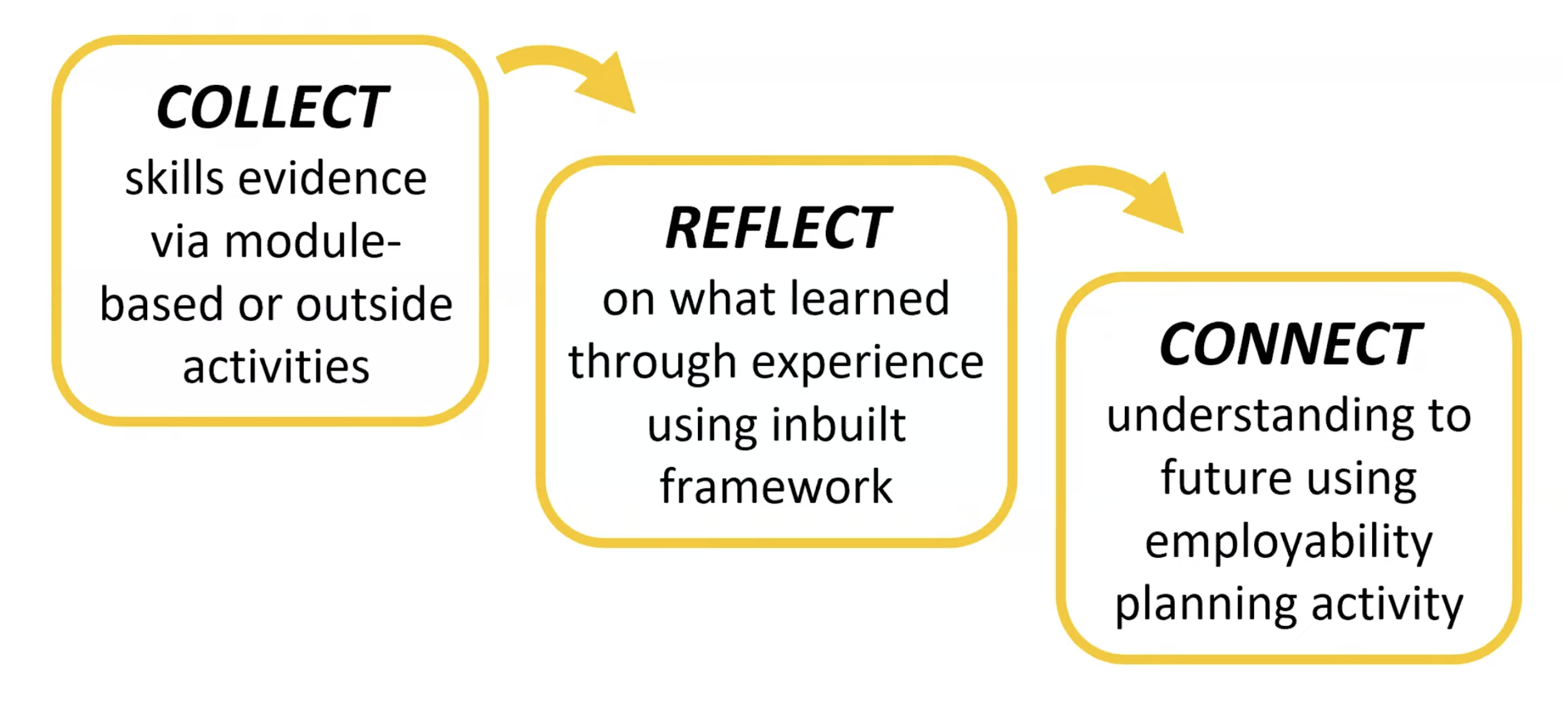
The Business School’s PebblePad‑based approach revolves around a simple but powerful three‑step model:
1. Collect
Students gather evidence from their academic work and their lived experiences – for instance, caring responsibilities, part‑time work, volunteering, sports, community involvement, etc. Crucial to this was how the students were prompted as Becky noted:
“We really made sure that students were very aware of opportunities to collect evidence … giving students a [starter for ten].”
2. Reflect
Students use templates like Borton’s ‘What? So what? Now what?’ or STAR (Situation, Task, Action, Result) to convert experience into understanding. The impact was immediate and dramatic, said Becky:
“We got seven times the reflections on one use of this workbook than we did on a module where we didn’t have the workbook. We had over a thousand reflections for one hundred and forty five students.”
3. Connect
Students link reflective insight to their emerging ambitions – and this is where ‘Future Skills’ earns its name, explained Becky:
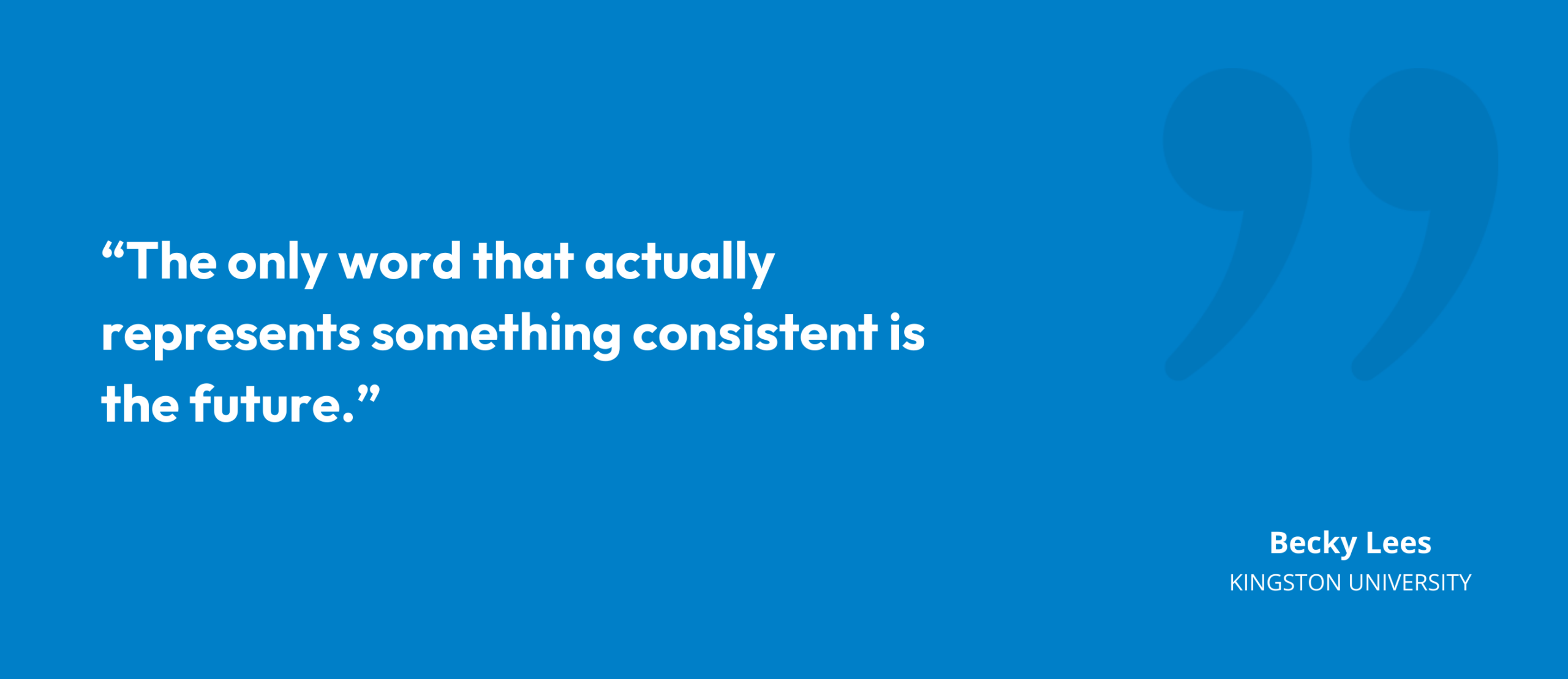
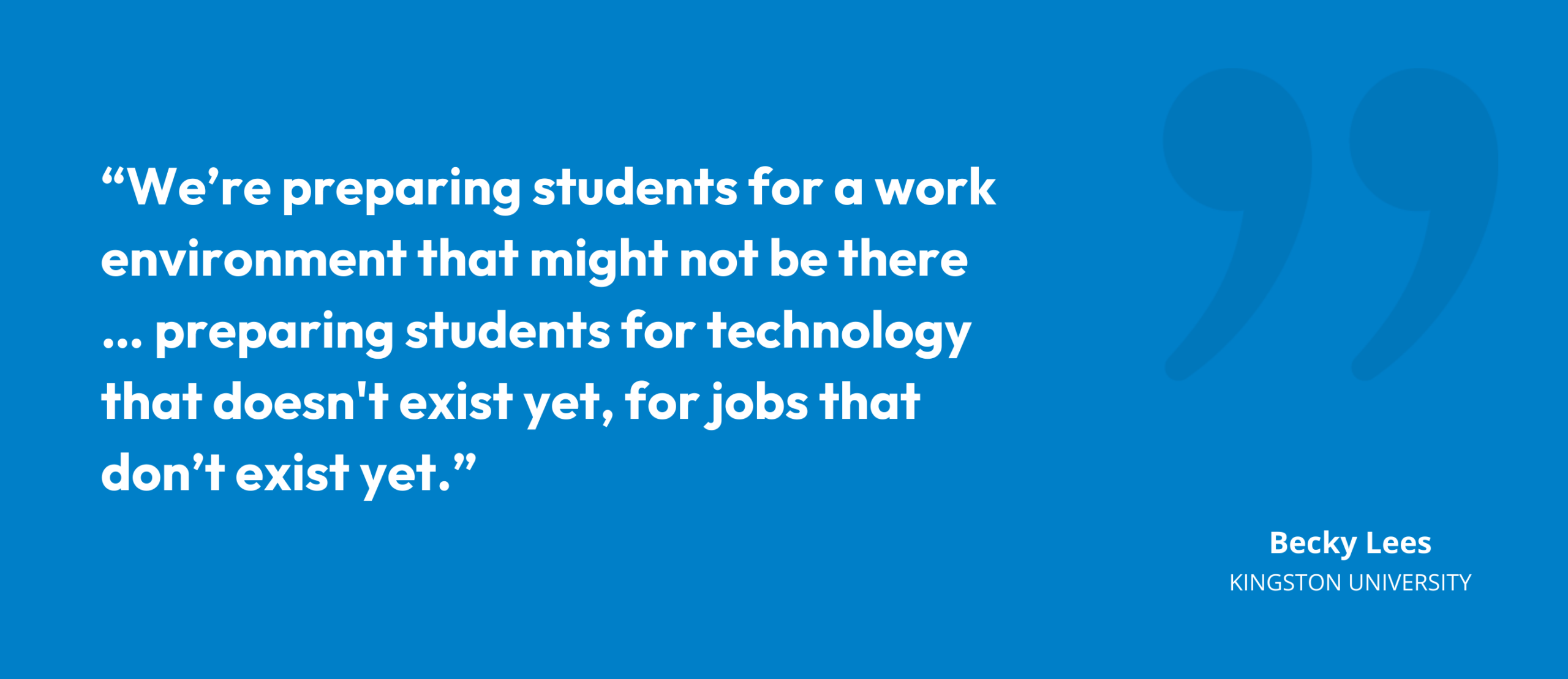
“We use the word future because we just don’t know what the workplace is going to look like … We’re preparing students to get ready for jobs that don’t even exist yet.”
A workbook that travels with students
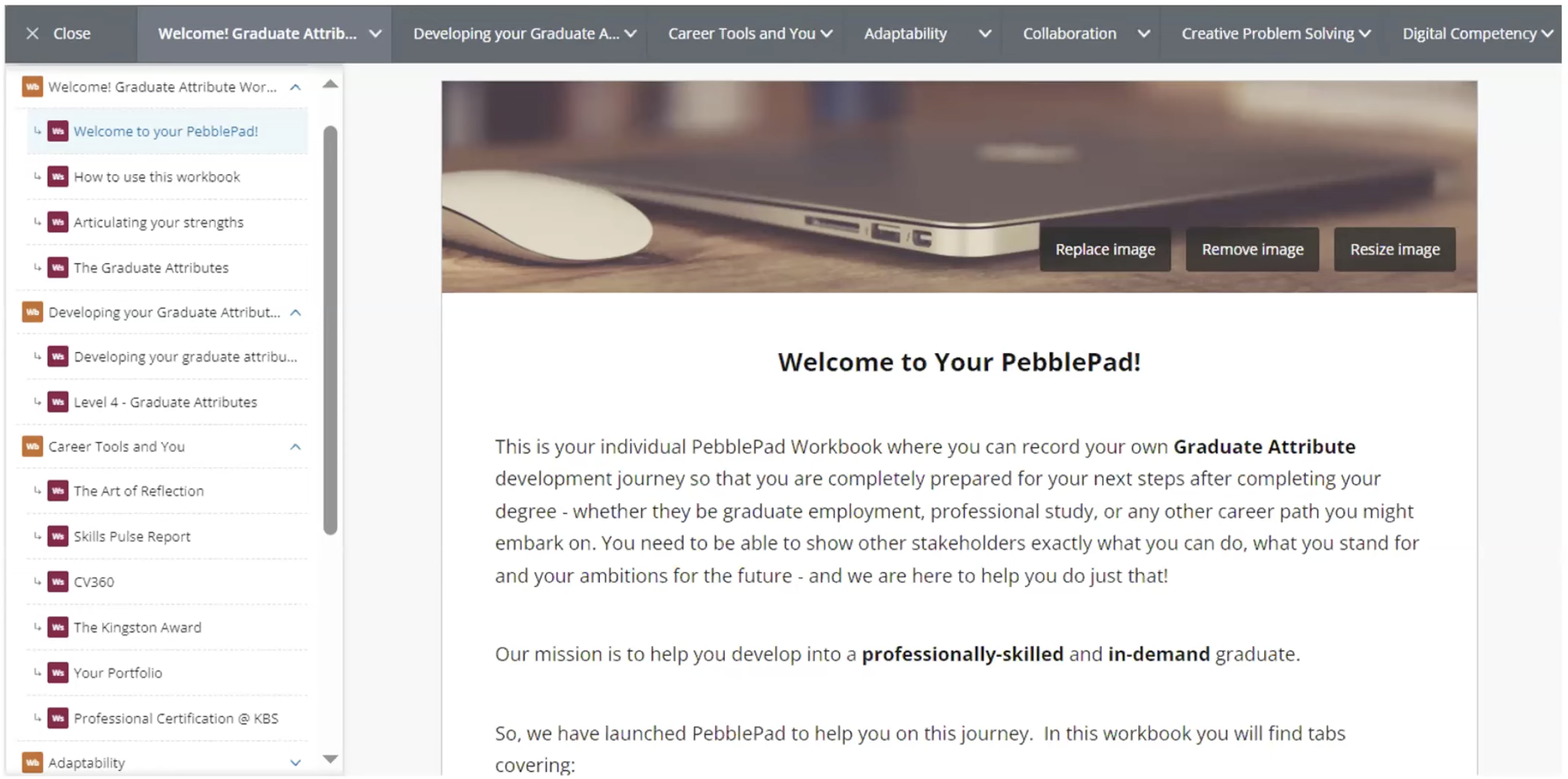
One of the most impactful design choices in Kingston Business School’s approach was creating a PebblePad workbook that stays with students from their first year through to final year. Instead of losing reflections or starting from scratch each September, students carry everything forward – early diagnostics, curated evidence, identity‑building activities and the reflections that capture their growth.
As Becky Lees described, shifting the Year 1 workbook into Year 2 meant students suddenly had a clear, continuous record of development. She explained: “What’s really been great this year [was] we had a really big move taking our workbooks that were the first year workbooks and moving them to level five.
“[It’s been] transformational because it means that everything [students] need from the first year is there … there are no barriers to accessing their content and they can look at it very easily [and see] … ‘Oh yeah, I did that last year. How have I progressed?’”
Tangible results
This continuity makes progress feel tangible and rewarding. Students can revisit earlier work, see how their thinking has evolved and build on what they’ve already captured rather than recreating it. Because the PebblePad workbook sits in the same place within the VLE and is accessible from any device, adding evidence and reflections becomes a natural habit rather than an arduous extra task.
For many students, especially those newer to higher‑education norms, the workbook also acts as an anchor. It helps them recognise that their skills are developing, that their reflections matter and that they are shaping a meaningful narrative about who they are becoming. Instead of viewing modules as disconnected experiences, the PebblePad workbook turns three years of learning into a single, cumulative story – one students can see unfolding right in front of them.
![“It’s improved [student] confidence … [After all] if you don’t capture the reflections in the moment, chances are students won’t be engaging with [it afterwards].” Becky Lees, Director of Learning & Teaching, Kingston University](https://pebblepad.com/wp-content/uploads/2026/03/Kingston4-scaled.png)
Unearthing the power of hidden data
Because PebblePad captures reflections in structured formats, Becky’s team also gained access to rich data insights that traditional assessments never revealed. Examining reflections on collaboration, for example, showed most students understood collaborative behaviours at a surface level (teamwork, communication) but struggled to articulate deeper collaborative competencies like coordinating across systems or managing relational complexities.
This allowed the team to refine prompts, adapt workshops and strengthen curriculum design. “It’s like a formative assessment [allowing us to] reflect back on our understanding of the students’ understanding and then to go back and plug [any] gaps where needed,” Becky explained.
Lessons from Kingston’s journey
The university’s work highlights lessons that extend far beyond a single faculty or framework. One of the most striking findings was how quickly students embraced the Future Skills workbooks. Because they were embedded directly into modules and assessments – not offered as an optional extra – students immediately recognised their relevance.
This integration made engagement feel natural rather than forced. Crucially, it reinforced that developing, reflecting on and articulating their skills was a core part of their academic journey rather than a bolt‑on or an exercise in busywork.
Staff engagement required a different investment. Pedagogical development needs time, space and thoughtful support, and Kingston’s experience showed that colleagues benefit from opportunities to explore the underpinning theory, understand the scaffolding and see how reflective tools deepen learning. While this took patience, the long‑term impact has been clear: richer reflections, stronger student ownership of skills and a shared employability language across programmes.
Expanding horizons
A key enabler for the Future Skills approach has been the scalability of the PebblePad workbook templates. Once designed, they could be adapted across diverse contexts – from Business School programmes to pharmacy and real estate – without losing coherence. This reusability allowed Kingston to extend Future Skills rapidly and consistently, ensuring every student encountered structured opportunities to collect, reflect and connect.
Perhaps the most significant lesson, though, is that identity matters as much as employability. As Becky Lees noted, many students don’t initially think in terms of careers at all. Instead, the framework creates a space for them to consider who they are becoming, what matters to them and how their experiences shape an emerging professional identity.
By centring identity alongside skills, Kingston has ensured Future Skills isn’t simply about meeting employer expectations – but about helping students build the clarity and confidence they need to navigate unfamiliar futures with genuine agency.
A model for the future
Kingston University’s Future Skills framework demonstrates what becomes possible when employability is treated not as an end‑point, but as an evolving mindset – one that encourages students to understand themselves, their strengths and their trajectory. It is an approach that prioritises self‑awareness, reflective practice, adaptability and confidence, giving students a clearer sense of how they learn and who they are becoming.
As PebblePad’s Shane Sutherland put it, quoting Michigan Tech University’s Maria Bergstrom, “we can never adapt our curriculum quickly enough … so we must teach our students to be future ready.” By embedding this principle across every programme, Kingston is preparing students to meet such change with clarity, resilience and confidence.
Watch the webinar
Get more expert insights and practical examples by clicking here for the full on-demand session.