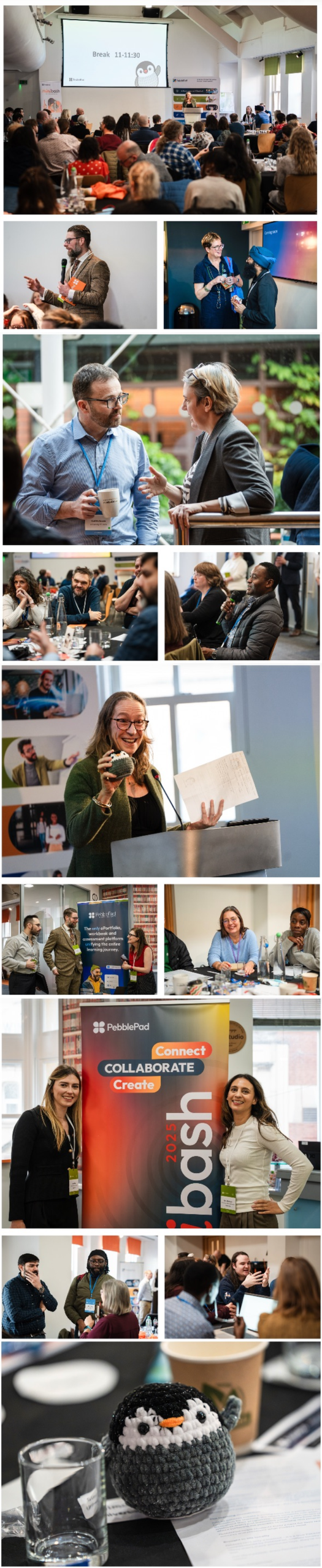





At MiniBash 2025, educators from across the UK and beyond shared stories of transformation, revealing six themes shaping the future of learning and assessment.
MiniBash has always been less about technology and more about the people who use it. The educators who sit with students grappling with reflection; the mentors navigating new assessment models; the administrators wrestling with consistency, compliance and care.
MiniBash 2025 brought those stories to the surface. Whether from a pharmacy programme in Birmingham, UK, a teacher training partnership stretched across many countries or an engineering faculty still taking its first steps into reflective practice, presenters spoke openly and honestly about what’s working – and what isn’t.
Across these stories, six themes cut through – ones based not on abstract principles but the back-to-basics realities of implementing best practice in reflection, learning, assessment, assurance, scalability and more:
1. Scaffolding Reflection to Deepen Learning
Across MiniBash, presenters stressed that students don’t automatically know how to reflect; they need structures that help them move beyond description and into meaning.
At Aston University, Pharmacy Educator, Mangalpreet Singh, explained how postgraduate students struggled when asked to write reflections in a single open box. Even with prompts, they weren’t sure how to analyse their experiences as Singh explained: “We put some prompting questions at the start and then left a large enough box for them to fill out … [but] a lot of students were narrating a lot of things, being very descriptive rather than being very reflective … they still felt they needed some sort of direction … a black and white prescription.”
To support students, Singh introduced smaller, guided sections – including feelings, reactions, perspectives and future planning – which helped students understand what reflective depth looked like and “to move beyond that descriptive stage and to start thinking about prompting and thinking about actually ‘what have I just seen?’,” he said.
![“When you broke that reflection down to smaller chunks, students were able to move beyond [the] descriptive stage.” Mangalpreet Singh, Aston University at MiniBash 2025](https://pebblepad.com/wp-content/uploads/2026/02/MiniBash-2025-scaled.png)
2. Making Hidden Learning Visible
A theme closely tied to reflection was the quiet problem of hidden or ‘buried’ learning. Students weren’t forgetting content – they simply couldn’t find it again.
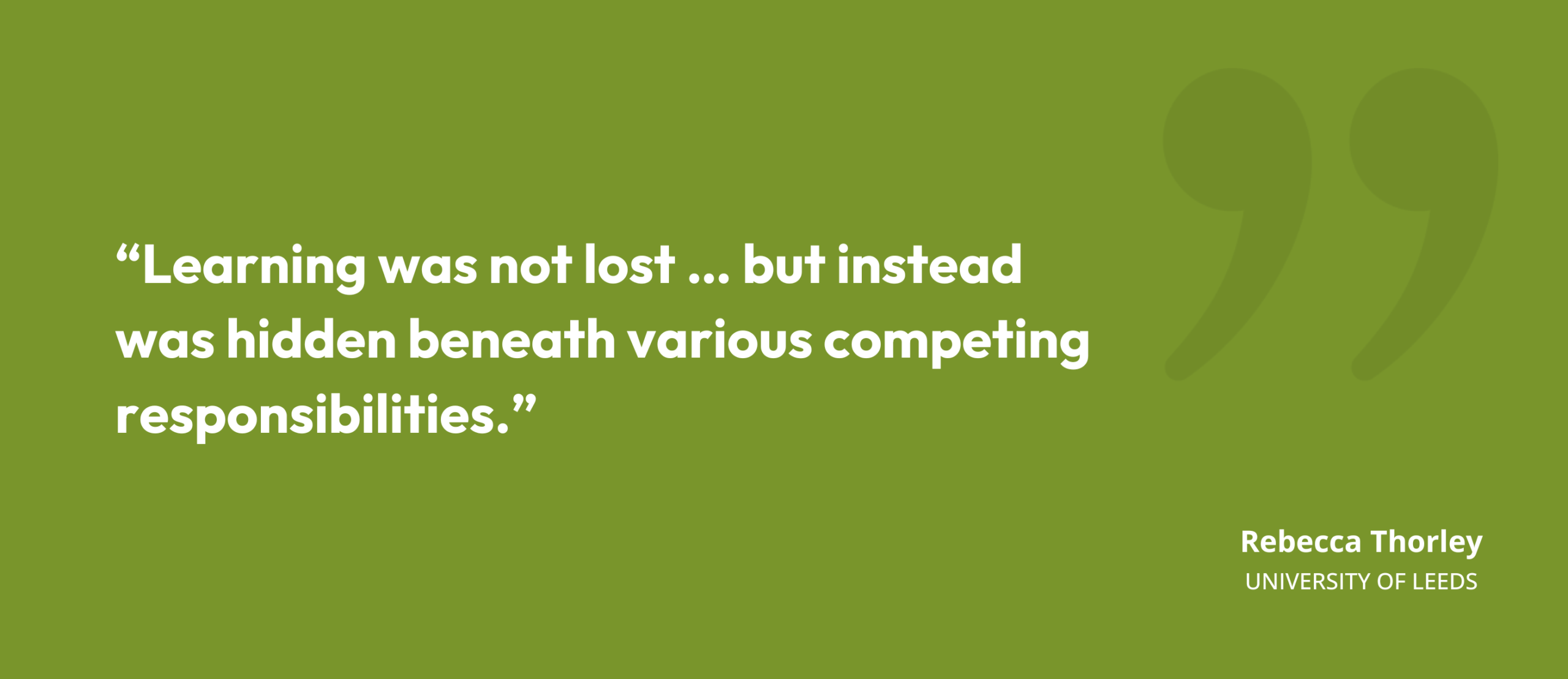
The University of Leeds’ Deputy Programme Manager Rebecca Thorley described this vividly. In her PGCAP research, she found that mature, part‑time learners were applying theory in their everyday lives without recognising it as learning. She described how “learning was not lost during the summer months but instead was hidden beneath various competing responsibilities … and needed to be brought to the surface when required.” Like many of MiniBash’s presenters, PebblePad became that surface for Thorley. Her PebblePad workbook What? / So What? / Now What? now gives students a route back to their own insight, helping them reconnect experience with meaning rather than treating reflection as an abstract task.
Dr Becky Lees, Director of Learning & Teaching at Kingston University’s Business School, saw a similar pattern. “Students could understand and articulate skills, knowledge and experience, but what they weren’t so good about was articulating things like networking, mindset, identity formation [and] cultural awareness,” she explained – the qualities that shape how someone understands themselves as a graduate.
Developing identities
To help define these qualities, her team built an employability framework around collect–reflect–connect, encouraging students to draw evidence not only from coursework, but from sport, family life, caring roles and part‑time work. For instance, one student wrote about leading a football team at halftime, noticing how they “highlighted the positives” and reframed the group’s energy. Another reflected on overcoming an unmotivated group in a module project. These weren’t academic tasks; they were moments of students becoming who they are as graduates.
Lees noted that the result wasn’t just more reflection – it was better reflection. “[For just one module], we’ve had over a thousand reflections so far,” she told MiniBash 2025. “We’ve never had that level of reflections. The more [students] reflect, the more they’re getting used to reflecting.” And this innovative approach has already had an impact. Staff report seeing increased confidence, clearer articulation of personal strengths and a stronger sense of professional identity in their students.
3. Redesigning Assessment to Be Meaningful and Authentic
If reflection helps students understand themselves, authentic assessment helps them show the world who they are becoming.
In teacher education at the University of Sunderland, lecturers Martin Holt and Simon Sheard described the dramatic shift from written submissions to dialogic, triadic assessment – a live conversation between trainee, mentor and academic. PebblePad became the shared space holding evidence, recordings, presentations and feedback. The result was a kind of professional apprenticeship in action.
During one meeting, Sheard described watching a trainee in China share her presentation while he and the trainee’s mentor assessed her live using a rubric on the same PebblePad page. Nothing was hidden. “Everything happens within that hour,” Sheard said – referring to the complete loop of evidence review, discussion, assessment and feedforward completed by the academic and mentor during the session.
Students, especially those working internationally, responded with relief. “It gives them that simple, organised structure,” said Holt. Mentors appreciated the clarity too, particularly the ability to delay releasing feedback until the right moment: “That save‑and‑hold is really powerful,” one mentor told Holt.
Examples of such authenticity took on many forms at MiniBash 2025:
- Business students recording mock interview responses and uploading digital artifacts
- Engineering students creating videos, infographics and evidence worksheets
- Apprentices documenting complex tests, echo traces and case‑based discussions
- Trainee teachers filming themselves explaining maths and science concepts
Importantly, each example anchored assessment in lived practice, and was not just an exercise to ensure the right box was ticked at the right time.
![“The dialogic assessment is personal [to each learner] and it doesn’t look the same for any two trainees.” Simon Sheard, University of Sunderland](https://pebblepad.com/wp-content/uploads/2026/02/MiniBash-2025-3-scaled.png)
4. Streamlining Evidence and Designing Portfolios That Actually Work
As authentic assessment grows so does the volume – and complexity – of evidence. Several presenters spoke openly about the anxiety this created in staff.
At Sheffield Hallam University, Senior Lecturer Dr Nicola Aberdein described the early years of the degree apprenticeship in healthcare science. Students gathered hundreds of pieces of visual evidence each year – ECGs, catheterisation traces, interpretation sheets – leaving supervisors drowning in artefacts. Aberdein set about designing a PebblePad workbook with a plea from one clinical tutor still in the front of her mind: “Don’t make my life harder. Don’t make me open hundreds and hundreds of items.”
Aberdein said: “I went back to basics and I thought, do we want our very busy clinical work-based supervisors opening endless amounts of evidence blocks?”. Her solution was elegant, redesiging the workbook around embedded ePortfolio pages, giving students freedom over layout while reducing assessor load. For instance, students could place a blood pressure chart next to an interpretation, feedback forms and colour‑code their pages (“[I did have] to rein them back in to begin with,” she noted). Assessors, meanwhile, could scroll through evidence in minutes, not hours.
Widening impact
What started as a usability improvement had pedagogic impact too as students took pride in their ePortfolios. The degree apprenticeship shifted from pass/fail evidence-checking to graded demonstration of professional growth. And when apprentices reached their end‑point assessment, they could rapidly navigate three years of evidence to tell the story of their development.
At the University of Leeds, Learning Technologist Lucy Thacker faced a different challenge: bringing PebblePad to engineering students and staff who had never encountered reflective practice before. The scale was enormous – thousands of learners, multiple departments and accreditation requirements needing immediate solutions.
Thacker’s faculty created programme‑wide templates in PebblePad, “reducing the need to start from scratch” she said and giving every student the same backbone while allowing each discipline to customise skills, outputs and assessment. It was structure in service of flexibility – and a model other faculty at Leeds are now adopting.
![“Students took responsibility and pride in the way in which they presented their work … [I was also] able to reduce the time that the assessors took to traverse through the workbooks [instead of opening up individual evidence blocks], which they were obviously very grateful for.” Dr Nicola Aberdein, Sheffield Hallam University](https://pebblepad.com/wp-content/uploads/2026/02/MiniBash-2025-4-scaled.png)
5. Strengthening Partnerships and Improving Quality Assurance
In story after story, PebblePad emerged not just as a platform for students, but a shared meeting place for entire learning ecosystems.
The University of Sunderland team mapped the range of contributors involved in a single trainee teacher’s progress: school‑based mentors, international mentors, personal tutors, subject specialists, placement providers, and administrators. PebblePad became the one shared space where all of them could interact safely, consistently and asynchronously.
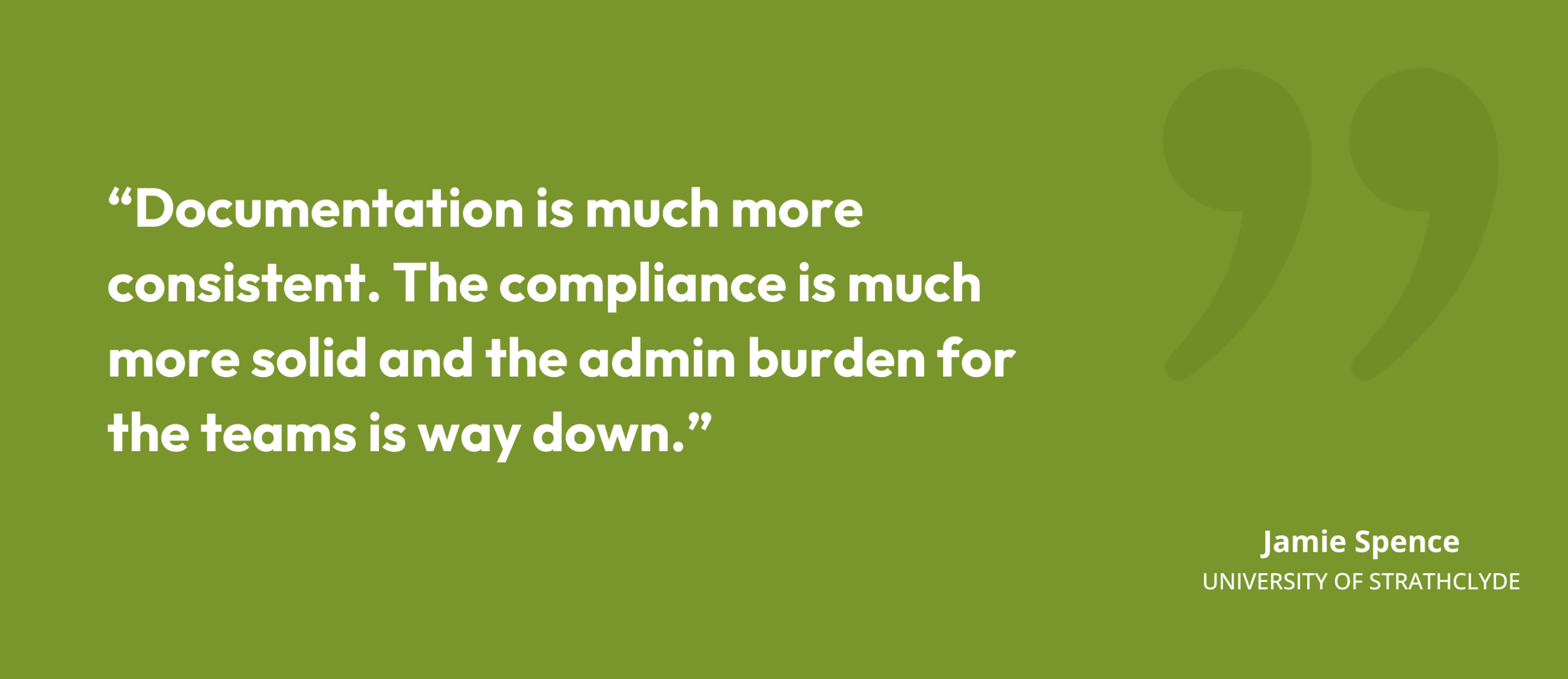
At the University of Strathclyde, Learning Technologist Jamie Spence described how this kind of shared structure transformed the quality of degree‑apprenticeship progress reviews. Previously, reviews were inconsistent and paperwork-heavy. “[The paperwork] was fragmented,” said Spence. “It was really difficult to track … the worst-case scenario would be jeopardising funding or certainly jeopardising quality assurance [because of an audit].”
By rebuilding the process in PebblePad, Spence used rule restrictions to ensure each party contributed only their part. Students reflected; academic mentors completed their sections; employers added theirs with everything time‑stamped and auditable.
“Apprentices are definitely more engaged,” said Spence about the transformative outcome. “They understand the process more. They understand that it’s a conversation. They understand the value of it rather than it just being a tick box exercise.”
6. Scaling Capability, Consistency and Culture Change
The final theme isn’t about a specific pedagogic approach – it’s about what happens when an institution decides to rethink itself.
As Lead Learning Technologist at the University of East Anglia, Lexy Buchan spoke candidly about PebblePad’s rapid expansion – from 2,000 to 10,000 users in three years – and the huge surge of support tickets that came with it. Her team realised the problem wasn’t the tool; it was how they were onboarding people to PebblePad. Because of this, they decided to strip training down to its essentials. For example, for staff charged with creating workbooks, the advice was simple and direct: “Here is the burger menu. Here is the workbook. This is how you create it. Ignore everything else,” Buchan explained.
They paired this simplicity with careful consultation, background configuration, cohort‑level support and a clean escalation route. The result was not fewer questions, but better ones – and a staff body growing in confidence rather than dependence.
At Swansea University, Associate Professor Dr Rebecca Pratchett described a broader cultural shift. She realised that PebblePad had originally been used “as a scalpel”, a precise tool for the single job of creating structured workbooks. But as new needs emerged – wellbeing plans, dissertation supervision, industrial placements, distance learning and more – she realised PebblePad was “far more like a Swiss army knife.”
Her analogy of a hiking rucksack representing student learning also resonated across the room: Canvas as the big middle pocket holding everything with PebblePad as the top pocket, the place students go to find exactly what they need for learning.
And at Maastricht University, Project Manager and Educationalist (Online & Blended Learning) Ilse Sistermans showed where the sector is heading: towards programmatic assessment, where thousands of data points across a year are used to understand development, not just performance. PebblePad, she noted, is helping Maastricht build the infrastructure for this longitudinal, high‑trust model – one where “small pebbles” of feedback accumulate into a meaningful narrative of learning.
![“We’ve been using [PebblePad] so far as a bit of a scalpel ... [but] it is far more like a Swiss army knife. It can do lots of different things, and I want to make sure that we’re using all of those tools.” Dr Rebecca Pratchett, Swansea University](https://pebblepad.com/wp-content/uploads/2026/02/MiniBash-2025-6-scaled.png)
Community Learning in Public
What MiniBash 2025 offered wasn’t about perfection. It was something better: practice shared openly, honestly and generously:
- Build structures that deepen reflection
- Surface the learning students don’t realise they have
- Make assessment look and feel like real practice
- Design ePortfolios that work for humans, not systems
- Strengthen partnership through clarity and shared space
- Create cultures where reflective, authentic learning can scale
And PebblePad was present in every story – sometimes as the spark, sometimes as the scaffolding, always as the companion. But the heart of MiniBash 2025 was the educators themselves. The ones grappling with change, celebrating small wins and building futures where students understand themselves better – as learners, as professionals and as people.
Watch now
View a selection of presentation videos from MiniBash 2025 by clicking here.
A big thank you to the presenters for their time, insights and generous knowledge-sharing – from left to right:
First row: Mangalpreet Singh, Pharmacy Educator, Aston University • Rebecca Thorley, Deputy Programme Manager, University of Leeds • Ilse Sistermans, Project Manager and Educationalist (Online & Blended Learning), Maastricht University • Dr Nicola Aberdein, Senior Lecturer, Sheffield Hallam University
Second row: Simon Sheard and Martin Holt, Lecturers, University of Sunderland • Lucy Thacker, Learning Technologist, University of Leeds • Dr Becky Lees, Director of Learning & Teaching, Kingston University • Lexy Buchan, Lead Learning Technologist, University of East Anglia
Third row: Jamie Spence, Learning Technologist, University of Strathclyde • Dr Rebecca Pratchett, Associate Professor, Swansea University
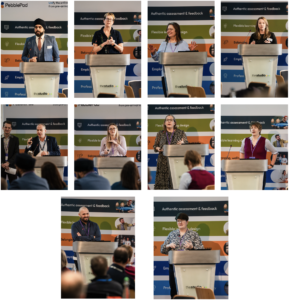
Snapshots of PebblePad’s MiniBash 2025
And a big thank you to everyone who attended from all over the world – it was fantastic to meet and talk to you all. Here’s to a successful 2026!