



Discover how De Montfort University’s Leisa Nichols-Drew has transformed the institution’s strategy for academic tutoring and block curriculum in forensic science using PebblePad.
Designing the right approach for tutoring and curricula can often feel like an exercise in forensics – gathering evidence, building processes and producing verified assessments. It represents a serious and complex challenge for any educator.
It’s why Associate Professor Leisa Nichols-Drew at De Montfort University (DMU) is uniquely qualified to innovative in this area using PebblePad ePortfolios. Her career began in 2000 at the Home Office’s Forensic Science Service, examining crime scene evidence and supporting the UK Criminal Justice System.
Today, Leisa has brought this expertise into academia, educating hundreds of students on the DMU’s Chartered Society of Forensic Sciences accredited programme. Here, we explore how she is leveraging the opportunities of block curriculum and academic tutoring, supporting student employability, and learning more about her PebblePad-focused chapter in the new book, ‘Creative Approaches to Personal Tutoring and Academic Advising’.
Designing a new approach to block curriculum
Leisa has been working with PebblePad since 2011, using it to strengthen employability in forensic science across several institutions. At DMU, she saw the same opportunity: “Health and Life Science is very much an applied faculty, and there’s lots of different healthcare specialisms,” she explains. “I knew as soon as we wanted to integrate a professional portfolio here, PebblePad was the way to go.”
Key to this choice is how PebblePad aligns so well with the faculty’s block curriculum approach – a series of four modules a year over a three-year course, which are underpinned by a zero-credit year-long professional portfolio module which is ‘where the PebblePad ePortfolio is integrated,” says Leisa. “The students work on it all through each year with the support of their academic tutor who then assesses this.”
Integrating PebblePad with DMU’s Virtual Learning Environment
To incorporate the ePortfolio, Leisa and her team created a PebblePad workbook that was integrated into the university’s virtual learning environment, effortlessly connecting with the digital learning ecosystem – “PebblePad’s compatible with so many different VLE formats,” explains Leisa. Also crucial was PebblePad’s certified data protection and risk management including ISO27001 and Cyber Essentials’ Certified and Certified Plus: “As a university, we’re always mindful of IT security … and PebblePad is accessible, safe and secure,” says Leisa.
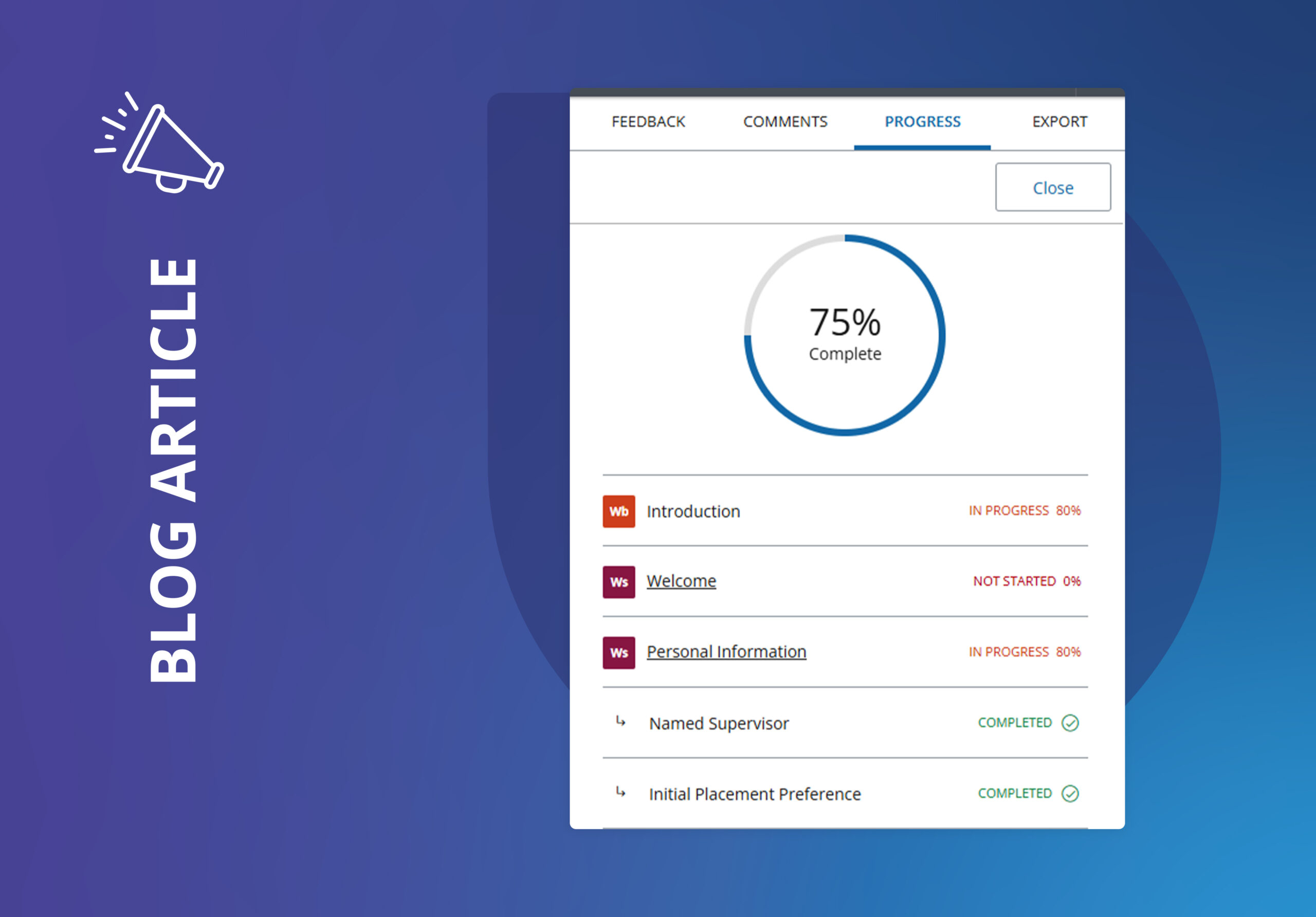
Once in place, students access and activate their workbook. Called the ‘Career Journey’, learners begin by setting out their career goals, what their aims are, creating targets and more. There’s also an events page where they can log any CPD activities as well as integrated reflective practice and support sections.
Taking ownership
“All of the students get the same workbook,” explains Leisa, “but it’s up to the student what types of evidence they choose to feature in it. For example, they can investigate a worldwide issue, an international company or explore themes in forensic science and criminal justice – whatever they are interested in … it’s for the students to take ownership and make it their own.”
Leisa also sees it as a significant research opportunity for learners. For example, within each degree, students are required to evidence the appropriate professional skills they have gained during their practical classes and workshops.
“The ePortfolio module underpins all of this, so it’s a constant thread running throughout the course,” she explains. “It’s integral to who we are as individuals, the subject and the programme.”
Building professional standards and accreditation
This approach helps students build a strong ePortfolio of evidence for accreditation with the Chartered Society of Forensic Sciences. “PebblePad makes it simple for learners to log their progress, reflect on achievements and plan,” says Leisa.
“It means rather than students thinking, “Oh, what’s next when I get to year three?”, they know from day one that these are our professional behaviours – that these are the standards – and they’re expected to have this ethos all the way through the programme.”
The approach also ensures high engagement from students and, importantly, enables educators to use the ePortfolios to more deeply support and interact with learners. “It encourages dialogue with our students,” says Leisa, “so that when they come to see us, we can go through it, as well as talk about other things.”
To successfully onboard students, Leisa has adopted a multi-tier approach. From large groups discussions and small group tutor sessions to one-to-one meetings, all learners are brought up to speed on how to utilise the platform – and why it’s important.
“PebblePad has become part of who we are and our identity,” explains Leisa. “It’s a pass-fail module so – while students don’t get a grade like they do with other modules – it’s in their best interest to pass because it will be on the end of their degree transcript when they graduate.”
Creating inclusive learning experiences with ePortfolios
The introduction of PebblePad has had a positive impact on student performance. “It has such good usability and it’s engaging,” Leisa explains. “It’s really inclusive for students – for people who learn in different ways.”
This level of accessibility is important to DMU as, “we are an inclusive institution with many students who may have specific learning requirements,” she says. “As a personal example, I was recently diagnosed with high-functioning dyslexia, so for me, PebblePad is really crucial.”
For instance, for her professional CMALT award application, Leisa created a PebblePad ePortfolio to evidence her work, instead of writing a traditional application. “For me, it was a game changer,” she recalls, “because it enabled me to articulate what I wanted to do to meet the criteria – without having to be worried about evidencing it in words … PebblePad enabled me to share my professional practice in a really engaging way.”
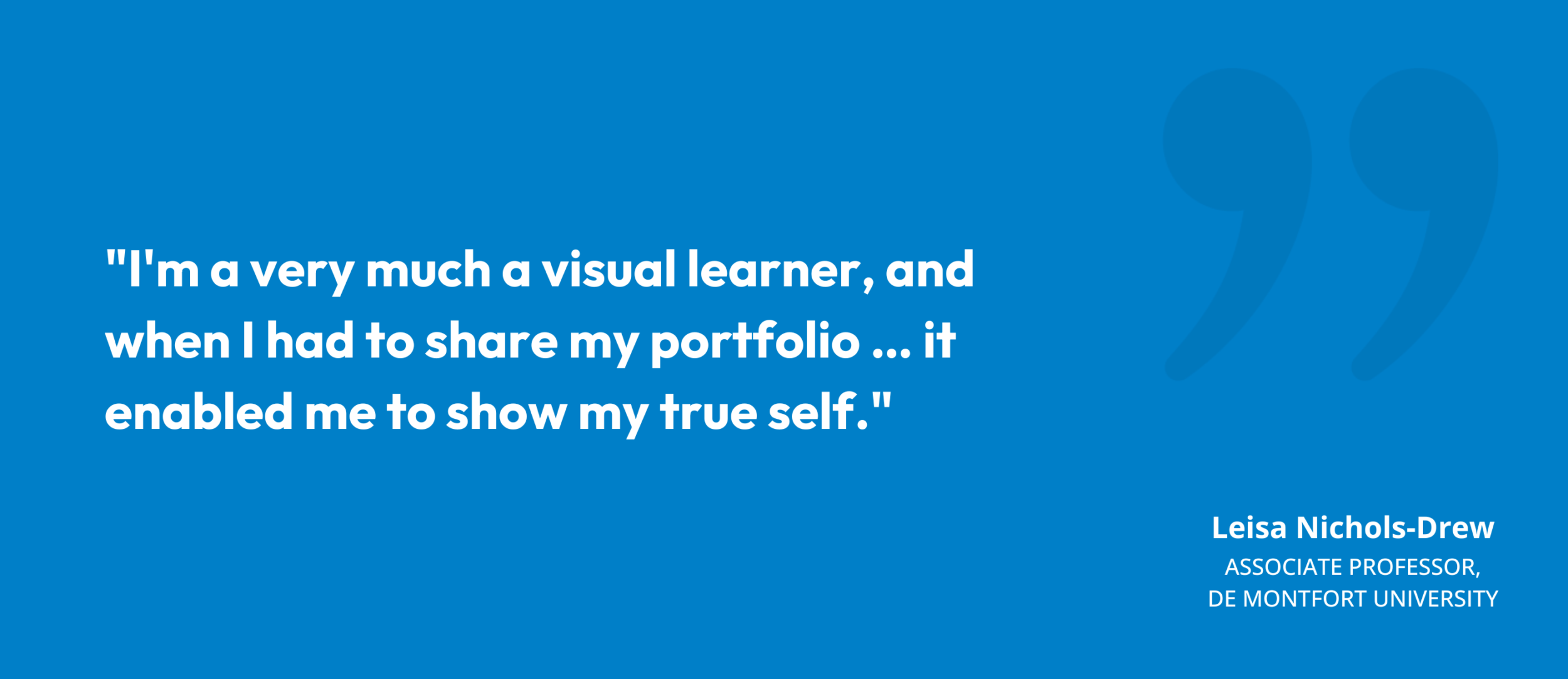
Themed pages within the DMU Forensic Science PebblePad ePortfolio
Scaling ePortfolios across faculties at DMU
Because of its performance, usability and ability to evidence professional skills, PebblePad is either being used or being rolled out in Audiology, Medicine and Healthcare as well as Pharmaceutical and Cosmetic Science and Pharmacy programmes. So successful has PebblePad’s adoption been within her own faculty, Leisa does hope its use will now spread across the entire university.
“[Each faculty] can make it their own and how they engage with their students,” she says. “[PebblePad] has so many possibilities. For example, when we’ve got students on placement, they have to evidence a piece of work that has its own module – and I can see the benefits of using PebblePad for that.”
Leisa also believes PebblePad is important for the progression and development of herself and her colleagues, “because we are an applied subject, we have to evidence our CPD ourselves … [so PebblePad’s] a natural fit for our faculty.”
From digital to print: Innovating with PebblePad
This belief in the transformative abilities of PebblePad led to Leisa to contributing to the new book, ‘Creative Approaches to Personal Tutoring and Academic Advising’. Her chapter, ‘PebblePad Portfolios’, offers more detail on how personal tutoring as a module is supported by the platform on two key fronts. First, by enabling the Leicester School of Pharmacy to integrate educators’ skills, personal tutoring, employability and sustainability and, secondly, by allowing students to show and demonstrate their unique experiences and critical reflection abilities.
Leisa concludes: “PebblePad is important for the students’ professional development and their progression through the course. It allows them to identify their own career goals – and what they want to achieve.”
Ultimately, she believes this approach reflects a shift from traditional pedagogy to heutagogy. It empowers learners to take ownership of their development and maintain a future-focused outlook that will be so vital to their success – not only at DMU – but throughout their careers in forensic science.
- You can order ‘Creative Approaches to Personal Tutoring and Academic Advising’ edited by Sue Beckingham and Wendy Garnham from the Routledge website by clicking here.