




In December last year, PebblePad headed to the 14th Eportfolio Forum in Australia to explore how ePortfolio practice is helping to deliver outstanding educational, professional and lifelong learning.
For this special event, PebblePad’s Co-Founder and Chief Academic Officer, Shane Sutherland, delivered a video keynote ‘Reflecting – on Reflection’, featuring insights and reflections from over 20 years of experience in ePortfolio innovation.
Inspired by his journey alongside so many trailblazing customers in Australia and New Zealand, Shane offered a personal, witty and illuminating take on the enduring power of stories and reflection – and the importance of compost.
The power of stories
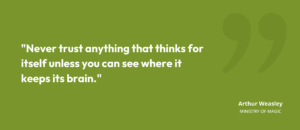
Shane opened with a wry Harry Potter quote, setting the tone for a talk that – much like Shane himself – was reflective and playful. This wasn’t a rigid lecture-like talk but Shane’s own personal story detailing his decades-long exploration of reflection through storytelling.
After all, stories matter. Not just those we tell each other, but the ones we tell ourselves. “Like you, I have many stories,” Shane shared. “Sometimes they run parallel, at other times they link and interleave – some stories may even contradict other stories we tell – perhaps a lesson for our times is that it’s okay to believe different things at the same time.”
The takeaway? It’s okay to hold multiple truths – even uncertainties – at once, so long as we remain curious. And for Shane, curiosity is a learning superpower, one that drives both reflection and storytelling, but as he pointed out, there are pitfalls.
Chained to our narratives
![“[In] Thomas King’s book, The Truth About Stories, he talks about the power of story and how people can be chained to stories … so a really powerful prompt I have used is asking students: “What does it mean to be chained to a story?”.” • Sonja Taylor, Portland State University, reflecting on story](https://pebblepad.com/wp-content/uploads/2025/12/Shane-Keynote-2-300x130.png)
The risk Sonja alludes to is obvious – we can end up chained to a single story that we repeat over and over, not only to others but to ourselves. “We’re all chained to our stories in some ways,” explained Shane. “To show ourselves, our programmes, our institutions in the best light. Our belief in the power of portfolios, or our platforms – even when we know there are flaws and inconsistencies in the stories we tell.”
This is something Shane has learned over the three decades he’s been involved in education – and for “the last 24 of which have been dreaming, scheming, building and promoting ePortfolios,” he explained. And for Shane, the APAC ePortfolio community has played a vital role in his understanding and practice; of keeping his curiosity strong – and those chains weak – so he can keep focusing on growth and reflection.
And compost heaps.
Feed your heap
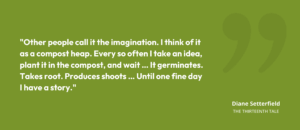
Quoting Setterfield, Shane likened the ‘fuel’ that drives stories and curiosity – our imaginations – to a compost heap. Life, where all our stories come from, are a rich, messy mix of experiences that, when turned over like compost, leads to new ideas and new stories.
“But those experiences are fleeting and ephemeral if not noticed, interrogated and, occasionally, made sense of,” Shane argued – much like the experience of learning itself. “[It’s why] we all believe that portfolios help turbo-charge [the reflection] process.”
His decades of experience have taught Shane that portfolios help us notice, reflect and make sense of these fleeting experiences. It’s what makes them so essential for learning. To underline this, Shane quoted David Baume – that the developmental portfolio is “a compost heap … something refined over time, enriched by addition, reduction and turning over”.
How it all began
This approach perfectly captures Shane’s own personal story of learning, curiosity and experiences of that compost heap. To understand why, he took us on a whistlestop tour of his life. From sailing instructor and firefighter to senior lecturer at university, one thing always caught Shane’s attention – his constant curiosity about if he was teaching well, and the instructing process itself.
“My first year in the classroom was characterised by lots of discussion, hands-on learning and maximum engagement,” said Shane, recalling his early days as a lecturer.
But he also remembers anxious students who didn’t think they were learning anything because, in his enthusiasm to share as much as he could, Shane realised he was neglecting to build in opportunities for students to pause, reflect, create connections – or just plain make sense of things.
Shane likened it to, “overfilling the middle of the sandwich – and missing the essential bits of the bun that helped you keep control of the meat.”
Take a moment…

It was during this time that Shane remembered the importance of pausing and reflection offered by the briefing and debriefing sessions he held when he was a sailing instructor – and their reflective benefits. Shane explained: “‘Reflect’ is a really simple word masking a very rich, sometimes complex, occasionally discomforting process that requires support and scaffolding.”
As a lecturer, this complexity was exacerbated because his students lacked a repertoire of questions so essential for reflection and making sense of learning. In turn, it risked threatening the curiosity that underpins the learning journey.
“[Because of this] I became a collector of questions and designs,” said Shane. “Of course, the questions don’t need to be complex – witness the widespread use of ‘What? So what? Now what?’.”
For Shane, these questions provided a simple scaffolding; a structure, a starting point that reduces “the tyranny of the blank sheet of paper” – and instead, encourages curiosity and primes the compost heap.
PebblePad is born
This concept of scaffolding formed the basis for PebblePad (as well as being triggered by memories of Shane having his best portfolio thrown from a first-floor office window into a skip). It led to the creation of the original classic PebblePad, launched way back in 2005 and shown at the 2008 Australian ePortfolio Symposium in Brisbane.
PebblePad back then may have been basic – you couldn’t even see all of the questions at once – but that trip led to PebblePad being used in eight pilots and projects at Murdoch, La Trobe, UTAS, RMIT, UniSA, Brisbane Catholic Education, University of Southern Queensland, Student Guild, and Flinders.
What this community went on to achieve with PebblePad astonished Shane – “the institutions blazed a way forward using innovation, creativity and impact”. From the Kosiosco Wilderness Walk at La Trobe to career self-management at Griffith, it opened Shane’s eyes to PebblePad’s huge potential – and, critically, increased his understanding of just how important the role of reflection is in learning.
Deeper into reflection
Most reflection models start with experience, explained Shane. Whether it’s Joplin, Lewin, Kolb, Gibbs or Deming, it boils down to essentially four key stages:
- Have an experience
- Think about it
- Think about how to improve it
- Try out your theory
While Shane pointed out that he’s no fan of deep, introspective, almost voyeuristic highly personal reflections, he does believe “things like feeling comfortable or discomforted, nervous, excited, in a state of anticipation or dread, all seem to me to be reasonable things to include in reflections-for-learning.”
How to ‘Roll’ with it
Reflecting on reflecting, and reflecting on how complex it can seem, Shane wondered what a super simplified model might look like, and (somewhat mischievously) came up with the SSRR – the Super Simple Reflective Roll:
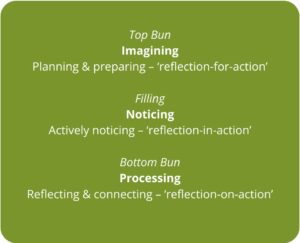
This roll is garnished with “wondering, imagination and curiosity – evaluated by the value or impact of the experience to the learner,” said Shane. He particularly enjoyed, experienced and appreciated the energy, effort and enthusiasm expended on the preparation phase – the reflection-for-action.
Not so quick
However, Shane did sound a note of caution about his simplification of reflection. “The simpler [reflection] becomes, the less amenable to assessment it is – unless reflection is analogous to thinking in which case we can assess the impact or outputs.”
But do we assess the impact or the outcomes? Or do we assess the quality of the inputs? Or is it about the questions that are levelled in the first place? After all, as John Dewey said, “a question well put is half answered.”
Problem solved?
To address these challenges, Shane believes that portfolios are an important part of the answer. “Our take is that planning and preparing, recording and reflection, connecting and sense-making are simple words belying complex activities,” he explained. “[It’s why] we created input templates before we even built the portfolio tool itself.”
But he warns about putting product before process – a portfolio should never be purely about showcasing. It’s much bigger than that with Shane wrapping up his talk by highlighting an insight from Dr Gayle Brent, formerly of Griffith University and now ColLab Educator at Bond University.
She states that, “the LMS model is flawed – it’s content and course centric, and the contributions of learners are often lost, or locked into the LMS.” Instead, with the right approach, she explained, “a structured portfolio can be used to guide student learning, enriched by their contributions, over as long as they want to engage with it.”
“And it becomes the property of the learner to return to whenever they want to revise, review or revisit their learning.”
Discover more insights
Learn how educators are transforming assessment and empowering learners with the power of the ePortfolio by watching the speaker presentations from PebblePad’s MiniBash Australia & New Zealand 2025.